

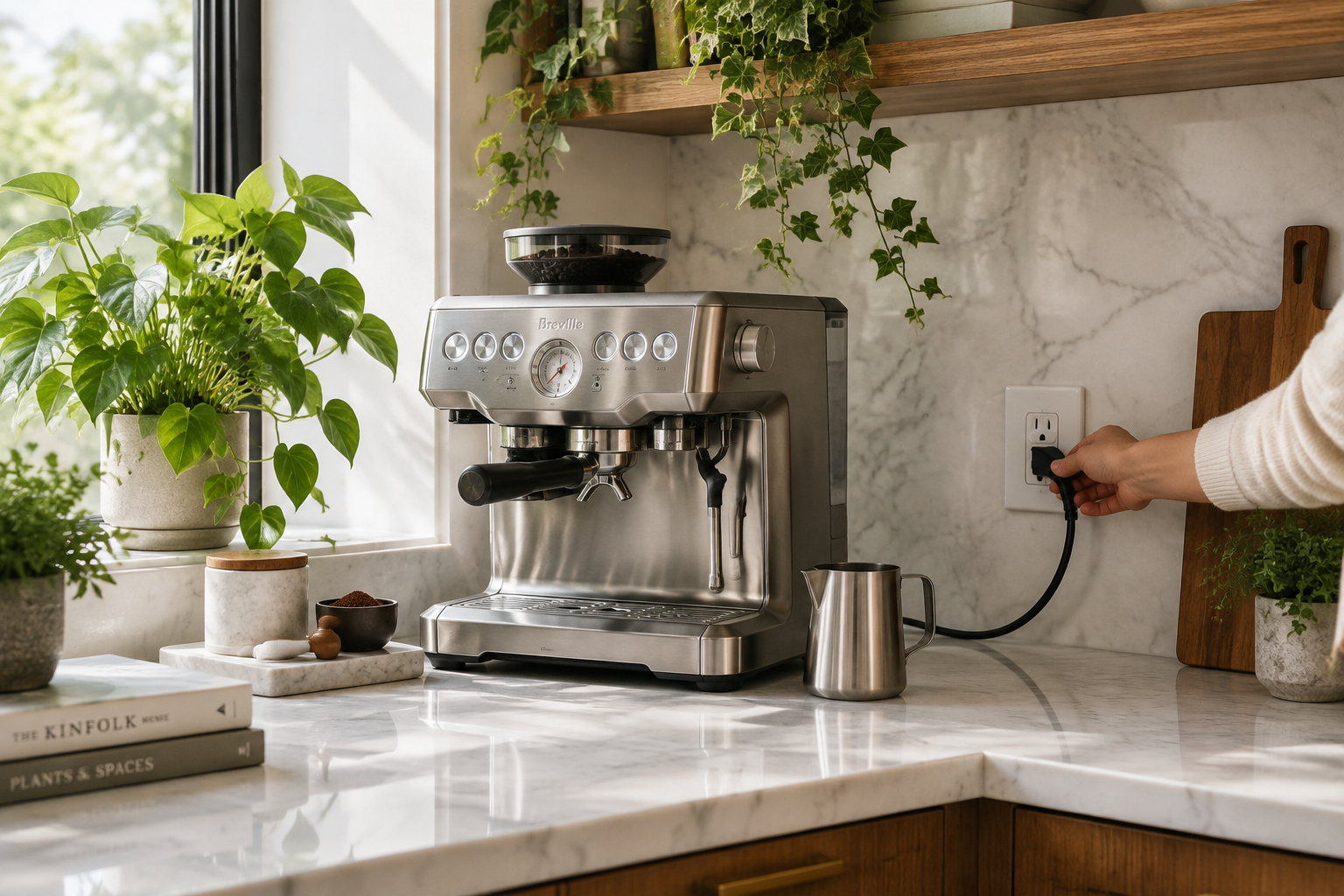
Yes — you can put an espresso machine on a smart plug, and for anyone with an E61 machine it's the single cheapest upgrade available.
A $25 plug turns a 25-to-30-minute warm-up into a machine that's ready when you walk into the kitchen. There are a few things worth knowing before you set one up, including one that most guides skip entirely.
Why it matters more on some machines than others
Warm-up time varies enormously by machine type:
- Thermoblock (Breville Bambino) — under 3 minutes. A smart plug adds nothing.
- Single boiler — 5 to 10 minutes. Marginal benefit.
- Heat exchanger — 15 to 25 minutes. Now it's useful.
- Dual boiler with an E61 group — 25 to 30 minutes, sometimes more. This is where a smart plug genuinely changes your morning.
The E61 group head is the reason. It's a heavy block of chrome-plated brass that has to come up to temperature by thermosiphon circulation, and no amount of boiler power hurries it. The boiler is ready long before the group is — which is why a machine that says it's hot after eight minutes still pulls a poor first shot.
We went through the numbers machine by machine in espresso machine warm-up time.
How to set it up
- Get a smart plug rated well above your machine's draw. Most espresso machines pull 1,200–1,600W. Buy a plug rated for at least 15A, and check the rating rather than assuming — this is the one place not to buy the cheapest option.
- Leave the machine's own power switch ON. The plug does the switching; the machine has to be set to come on when it receives power. Most do. Some with electronic soft-touch buttons don't, and won't work this way — check yours before you buy the plug.
- Set it 30 minutes before you want coffee. On at 6:00 for a 6:30 espresso.
- Set an off time too. Most people forget this, and it's the part that matters — see below.
Any brand works. This isn't a category where the expensive option buys you anything beyond the amperage rating.
The part most guides leave out
You're scheduling a 1,500W heating appliance to switch itself on in an empty kitchen. That deserves a moment's thought.
Check the water level the night before. This is the real risk. Most machines will run their heating element dry if the tank is empty, and on some that means a destroyed element. A few have low-water cutoffs; plenty don't. Make filling the tank part of shutting down for the night, not part of making coffee in the morning.
Always set an off time. If you sleep in, travel, or simply forget, you don't want the machine sitting at temperature all day — every day. It's a power draw and unnecessary wear on the element and seals.
Don't run it through an extension lead or a shared power strip. Straight into a wall outlet, on its own circuit if you can.
Check your warranty. Most manufacturers are fine with this — it's electrically identical to switching the machine on by hand — but if yours says otherwise, that's worth knowing before rather than after.
None of this is alarming. It's the same care you'd take with any appliance that heats itself unattended. It's just that nobody mentions it, and the tank is the one that bites people.
Voice control, if you want it
Most smart plugs pair with Alexa, Google Home or HomeKit, so "turn on the espresso machine" works fine. It's a genuinely nice thing to be able to say from bed.
Be realistic about what it does, though: you still wait 30 minutes. Voice control saves you the walk to the kitchen, not the warm-up. For that reason a schedule beats voice control for most people — the machine is ready before you've thought about wanting it.
The alternative: buy a faster machine
If warm-up is the thing that actually bothers you, a smart plug is a workaround rather than a fix. Some machines simply heat faster:
- Breville Bambino Plus — $499.95, ready in about 3 seconds
- LUCCA A53 Mini V2 — $2,595, saturated group rather than E61, and noticeably quicker to reach temperature
Our guide to espresso machines with the fastest warm-up times covers the full range.
But for most E61 owners, a $25 plug and a 6am schedule solves it completely — and you keep the machine you actually want.
The short version
Smart plug rated for 15A or better, machine's own switch left on, scheduled 30 minutes before you want coffee, with an off time set and a full water tank the night before. That's the whole thing.
Questions about your specific machine? Call us at 800-410-8867 — we'll tell you whether yours will come back on with the power.