

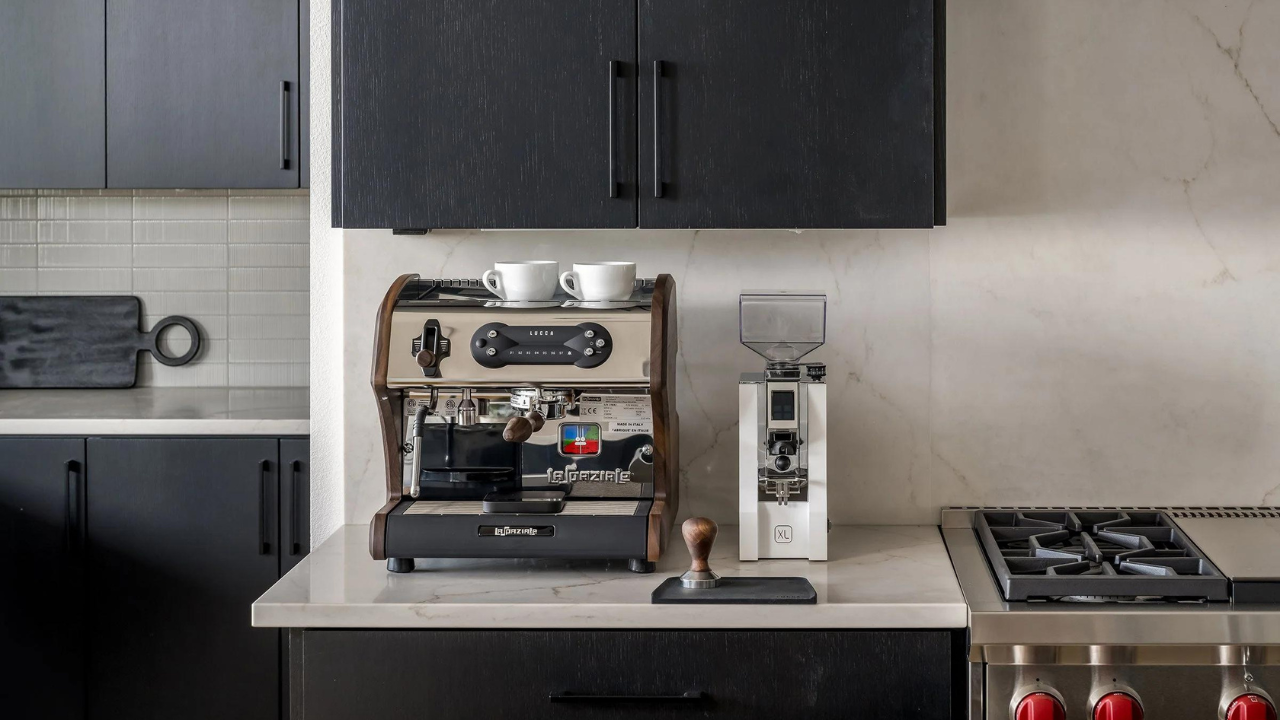
If you're shopping for a dual boiler espresso machine in the $1,800–$2,300 range, two machines keep coming up: the Lelit Elizabeth and the LUCCA A53 Mini. They're close enough in price to feel like a direct choice, but different enough in personality that the wrong pick can leave you frustrated.
We've used both. Here's what you actually need to know.
Shop the Lelit Elizabeth → Shop the LUCCA A53 Mini →
Quick Verdict
Choose the Lelit Elizabeth if you:
- ✔ Want a compact dual boiler that fits in a smaller kitchen
- ✔ Are budget-conscious and want the best value in this class
- ✔ Prefer a simpler, approachable workflow
- ✔ Don't regularly make multiple milk drinks back-to-back
Choose the LUCCA A53 Mini if you:
- ✔ Want a machine that feels and functions closer to commercial equipment
- ✔ Regularly steam milk for several drinks in a row
- ✔ Plan to use this machine daily for many years and want the most durable build
- ✔ Don't mind spending a little more for long-term confidence
Build Quality & Design
This is one of the clearest differences between the two machines.
The Lelit Elizabeth is a compact, well-built Italian machine with a clean modern design. It feels solid and purposeful on the counter, and the smaller footprint is genuinely meaningful — if your counter space is limited, the Elizabeth fits where the A53 Mini won't. It's a refined machine, but it's clearly built for the home.
The LUCCA A53 Mini is manufactured by La Spaziale, one of Italy's leading commercial espresso machine makers. When you handle it, you feel the difference. The components are heavier, the tolerances are tighter, and the overall build has a commercial confidence that the Elizabeth doesn't quite match. It's not dramatically larger, but it is noticeably more substantial.

Winner: A53 Mini — if long-term build quality is your priority, it's not a close comparison. But the Elizabeth is no slouch, and for the price difference, many buyers are perfectly happy with it.
Boiler System & Performance
Both machines use dual boilers, which means independent temperature control for brewing and steaming — a significant advantage over single boiler or heat exchanger machines.
The Elizabeth has a 0.6L steam boiler paired with a brew boiler, controlled via Lelit's LCC (Lelit Control Center) PID. Temperature stability is excellent, and the Elizabeth consistently pulls great shots day-to-day. Where it shows its limitation is back-to-back steaming — if you're making multiple milk drinks in a row, the smaller steam boiler can run out of steam pressure more noticeably than the A53.
The LUCCA A53 Mini runs a 1.2L steam boiler — double the Elizabeth's capacity — and benefits from La Spaziale's commercial engineering heritage. Steam is powerful and consistent. You can texture pitcher after pitcher without waiting for recovery. If your mornings involve making two or three lattes in a row, this matters more than any spec sheet number suggests.

Winner: A53 Mini — especially for milk drink volume. For straight espresso or occasional steaming, the Elizabeth holds its own.
Ease of Use & Workflow
The Elizabeth is one of the more intuitive dual boilers on the market. The LCC interface is clear, the machine heats up in under 20 minutes, and Lelit's pre-infusion system works seamlessly without much user input. For someone stepping up from a single boiler for the first time, the Elizabeth is approachable without feeling dumbed down.
The A53 Mini has a slightly more utilitarian feel — this is a machine built for people who want to make espresso, not navigate menus. Programmable volumetrics let you dial in your shot volumes and let the machine stop automatically, which is genuinely useful when you're also steaming milk. The front-loading water tank makes refills faster than on most machines, and heat-up is impressively quick given the boiler size — around 10–15 minutes.
Winner: Tie — the Elizabeth is slightly more beginner-friendly; the A53 is slightly more workflow-efficient for experienced users. Neither is difficult to learn.
Spec Comparison
| Feature | Lelit Elizabeth | LUCCA A53 Mini |
|---|---|---|
| Price | ~$1,799 | ~$2,595 |
| Boiler Type | Dual Boiler | Dual Boiler |
| Steam Boiler | 0.6L | 1.2L |
| Pump | Vibration | Vibration |
| Group Head | Lelit58 | Saturated (La Spaziale) |
| PID Control | Dual (LCC) | Dual |
| Pre-Infusion | Yes | Yes (chamber) |
| Plumbable | No | Yes |
| Footprint | Compact | Moderate |
| Made In | Italy | Italy |
| Warranty | 1 Year | 1 Year |
Price & Value
The Elizabeth comes in around $500 less than the A53 Mini. That's not nothing — it's most of a quality grinder, or a meaningful chunk of accessories.
If you're budget-conscious and prioritizing getting the best possible machine at the lower price point, the Elizabeth is genuinely excellent for the money. Most buyers at this level are very happy with it long-term.
If your budget stretches to the A53 and you'll be using this machine daily for the next decade, the extra investment tends to pay off. The commercial build quality means less long-term uncertainty, and the larger steam boiler means you'll never outgrow it as your coffee habits grow.
Our Take
We get asked to choose between these two machines regularly, and the honest answer is: it depends entirely on how you use your machine.
The Elizabeth is the right call if counter space is tight, you're more budget-conscious, or you're primarily pulling single or double shots with occasional steaming. It's a wonderful machine that won't let you down.
The A53 Mini earns the nod if your household runs through multiple lattes or cappuccinos every morning, you value the confidence of commercial construction, or you want a machine you'll never feel the urge to upgrade. The build quality difference is real, and over five or ten years of daily use, it shows up.
Both machines pull outstanding espresso day-to-day. The difference isn't in the cup — it's in the experience around it.

Try Either Machine Risk-Free
Still not sure? That's exactly why we offer a 365-day in-home trial on every machine we sell. Use it in your kitchen, pull shots with your beans, steam your milk, live with it — and if it's not right, we'll make it right. No other retailer in this space stands behind their machines the way we do.
Have questions? Our team has used both of these machines and is happy to help you decide. Chat with us or call 800-410-8867 — we're real people who love espresso, and we'll give you a straight answer.
Shop the Lelit Elizabeth → Shop the LUCCA A53 Mini →