

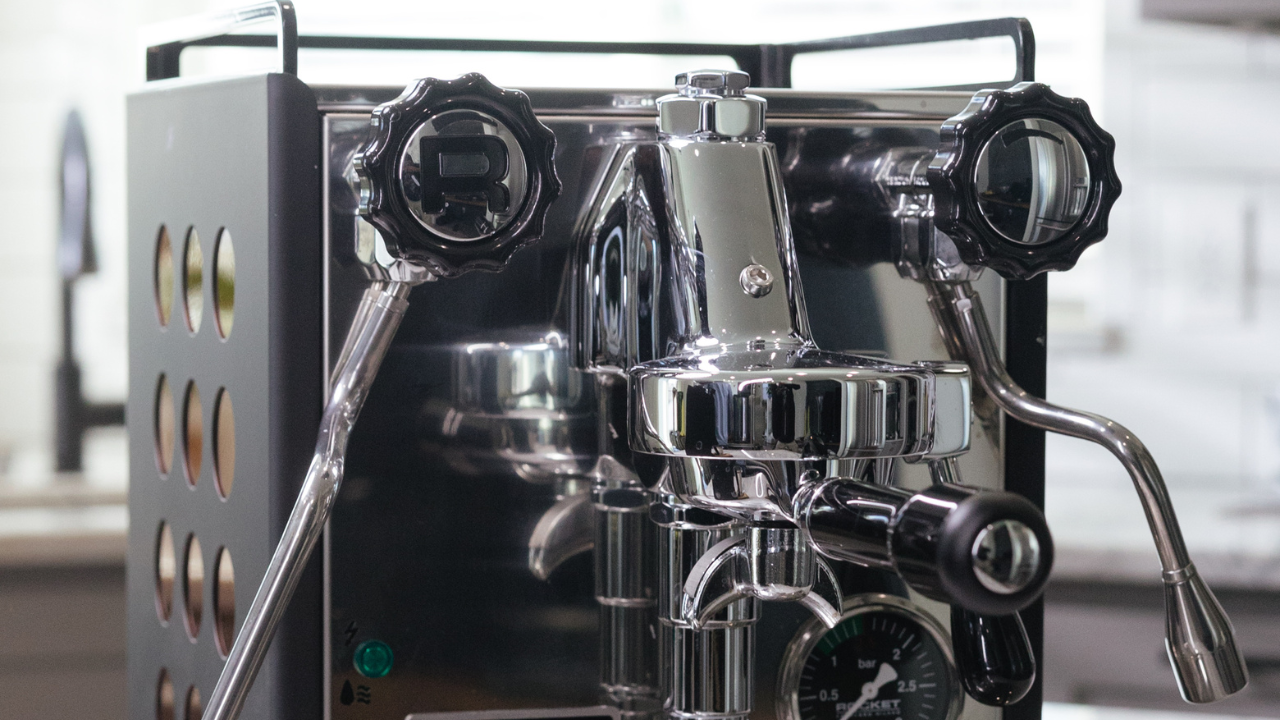
If the brew lever on your Rocket has gone stiff, gritty or squeaky, it needs grease. It's a fifteen-minute job, it costs about the price of a bag of coffee, and putting it off is how a smooth lever turns into a worn cam.
First, a clarification that matters: this is about the E61 brew lever — the chrome lever on the front of the group that you lift to start a shot. Every Rocket in the current range uses one, from the Appartamento TCA up. If you have an older spring-lever machine where you physically pull a piston down through the coffee, that's a different mechanism and a different job — call us rather than following this.
What's actually happening
Lift the lever on an E61 and you're rotating a cam inside the group. That cam pushes a rod which opens the brew valve, and on the way back down it also opens the three-way valve that releases pressure and dries the puck.
The cam and its pivot run on grease. Heat cycles every day, plus steam, plus time, and that grease migrates and dries out. Metal starts riding on metal.
What you feel, in rough order:
- The lever loses its smooth, weighted action
- A squeak or creak as you lift
- A gritty or notchy feeling mid-travel
- It doesn't drop back cleanly on its own
None of these affect the shot immediately. Left long enough, dry metal wears the cam and the bushings, and that stops being a fifteen-minute job.
What you need
Food-grade silicone grease. The standard across the industry is Molykote 111 — sold for years as Dow Corning 111. Super Lube food-grade silicone is the common alternative. A small tube lasts many years.
Two things it must be: food-safe, because it's inside a machine that makes your coffee, and silicone rather than petroleum-based. Petroleum greases attack rubber seals — you'll fix the lever and destroy the gaskets.
Do not use WD-40, cooking oil, bicycle grease or lithium grease. We get calls about all four.
Also: an appropriately sized hex key or screwdriver for the lever's retaining fastener (varies by model), lint-free cloths, and a cotton swab or two.
The job
1. Power off, unplug, and let it cool completely. Not warm — cool. The group is a large brass casting and it holds heat for a long time after the machine is off. Give it a couple of hours.
2. Release the pressure. Lift and lower the lever once with the machine off to let any residual pressure out of the group.
3. Remove the lever. There's a retaining screw or nut at the pivot where the lever meets the group. Undo it, note how the lever sits, and withdraw it. Put the fastener somewhere it can't roll away — it's small and specific to your machine.
4. Clean the cam and pivot. Old grease goes dark and tacky. Wipe it all off with a lint-free cloth and a cotton swab for the recesses. You want bare, dry metal before new grease goes on — fresh grease over old grit just distributes the grit.
5. Grease sparingly. A thin film on the cam surface and in the pivot bore. More is not better: excess grease squeezes out, collects coffee dust, and turns into the same gritty paste you just removed.
6. Reassemble. Lever back in its original orientation, fastener snug — firm, not cranked. It's brass and chrome, and it strips.
7. Work the lever a dozen times. It should feel smooth and weighted through the whole travel, and drop back cleanly. Wipe away anything that squeezes out.
8. Power up and pull a couple of throwaway shots before you make anything you intend to drink.
When it isn't a lubrication problem
Worth knowing before you take anything apart, because greasing won't help with any of these.
Scale. If the lever is stiff and flow has dropped, or the machine is slower to heat than it was, you have scale rather than dry grease. That's a different and more serious job. Our water guide covers how to stop it recurring, and the softening and filtration system ($250) is what prevents it.
A worn cam. If the lever has been dry for a long time, the cam face can wear. Grease will quiet it temporarily but the slop won't come back out. That's a parts job.
Valve trouble. If the lever feels fine but the group dribbles after the shot, or the puck comes out soupy, that's the three-way valve rather than the lever. Related mechanism, different fix.
If you're unsure which of these you have, call us and describe what it's doing. It takes two minutes and it's free.
How often
Once a year for a machine in daily home use, or whenever the action changes. There's no benefit to doing it more often — you're removing good grease to put new grease in.
Alongside it, the rest of the routine that actually keeps an E61 alive:
- Backflush weekly with detergent and the blind disc. Not every six weeks — weekly, if you use the machine daily.
- Group gasket every 9–12 months. A portafilter that has drifted well past 6 o'clock is the tell.
- Treat your water. This is the one that decides whether the machine lasts five years or twenty. Never use distilled or straight reverse osmosis — with almost nothing dissolved in it, the coffee extracts poorly and many machines won't even register water in the tank.
Browse Rocket machines · Browse cleaning supplies
Frequently asked questions
What lubricant should I use on an E61 lever?
Food-grade silicone grease. Molykote 111, formerly sold as Dow Corning 111, is the industry standard; food-grade Super Lube is a common alternative. It must be food-safe and silicone-based — petroleum greases degrade the rubber seals inside the group.
How often should I lubricate my Rocket's lever?
About once a year with daily use, or sooner if the action turns stiff, squeaky or gritty. More often than that achieves nothing — you'd be stripping out perfectly good grease.
Why is my E61 lever squeaking?
The grease on the cam and pivot has dried out or migrated, so metal is running on metal. It's the earliest warning sign, and it's worth acting on — running it dry for months wears the cam itself, which is a parts replacement rather than a service.
Can I use WD-40 on my espresso machine lever?
No. It isn't food-safe, it isn't a grease, and it will wash out what lubrication remains. The same applies to cooking oil, lithium grease and bicycle grease. Use food-grade silicone grease or nothing.
Is the lever stiff because of scale?
Possibly, and it's worth checking before you take anything apart. If the stiffness comes with reduced flow or slower heat-up, that points to scale rather than dry grease, and lubrication won't fix it. If the lever alone has changed and everything else is normal, it's grease.
Do all Rocket machines have an E61 lever?
Most do — the Appartamento TCA, Giotto and Mozzafiato FAST models and the R58 Tune all use an E61 group with the familiar chrome lever. The Bicocca uses a different heated group, and the R NINE ONE uses a saturated group, so the mechanism differs on both.
Should I take the whole group apart while I'm in there?
No. Removing the lever to clean and grease the cam is routine owner maintenance. Going further into the valve stack is not, and reassembling it wrong causes leaks that are worse than the problem you started with. If the fix needs more than the lever off, call someone.
The short version
Cool the machine fully, take the lever off at the pivot, clean off the old grease, apply a thin film of food-grade silicone grease to the cam and bore, and reassemble. Once a year. Never anything petroleum-based.
Not sure whether you're looking at dry grease, scale or a worn cam? Call us at 800-410-8867 and tell us how it feels. We'll know from the description.