

Before anything else: almost every Breville espresso machine uses a 54mm portafilter, not the 58mm size the rest of the espresso world standardised on. Buy the wrong one and it will not fit, and it's the single most common mistake people make here.
So start with the table below, confirm your model, and then read the rest.
Which size does your Breville use?
| Model | Name | Portafilter |
|---|---|---|
| BES500BSS | Bambino Plus | 54mm |
| BES870XL | Barista Express | 54mm |
| BES876BSS | Barista Express Impress | 54mm |
| BES878BSS | Barista Pro | 54mm |
| BES880BSS / BES881 | Barista Touch / Touch Impress | 54mm |
| BES840XL | The Infuser | 54mm |
| BES810BSS | Duo-Temp Pro | 54mm |
| BES900XL / BES920XL | Dual Boiler | 58mm |
| BES980XL | Oracle | 58mm |
| — | Oracle Jet | 58mm |
The pattern is straightforward: Breville's flagship machines use the industry-standard 58mm, and everything below them uses 54mm. If you own a Barista Express, a Bambino, a Barista Pro or a Barista Touch, you need 54mm.
If you're unsure, measure the inside diameter of the group head, or check the number stamped on the underside of your existing portafilter.
An honest note before we go further
We don't stock 54mm bottomless portafilters. Our portafilter range is 58mm, for the Lelit, Rocket and LUCCA machines we sell.
We could have written this page as a list of links to somewhere else with a commission attached — that's what it used to be, and we've taken those out. Instead: here's what to look for so you can buy a good one wherever you buy it, and what we'd actually recommend if you're on a 58mm machine.
What a bottomless portafilter actually does
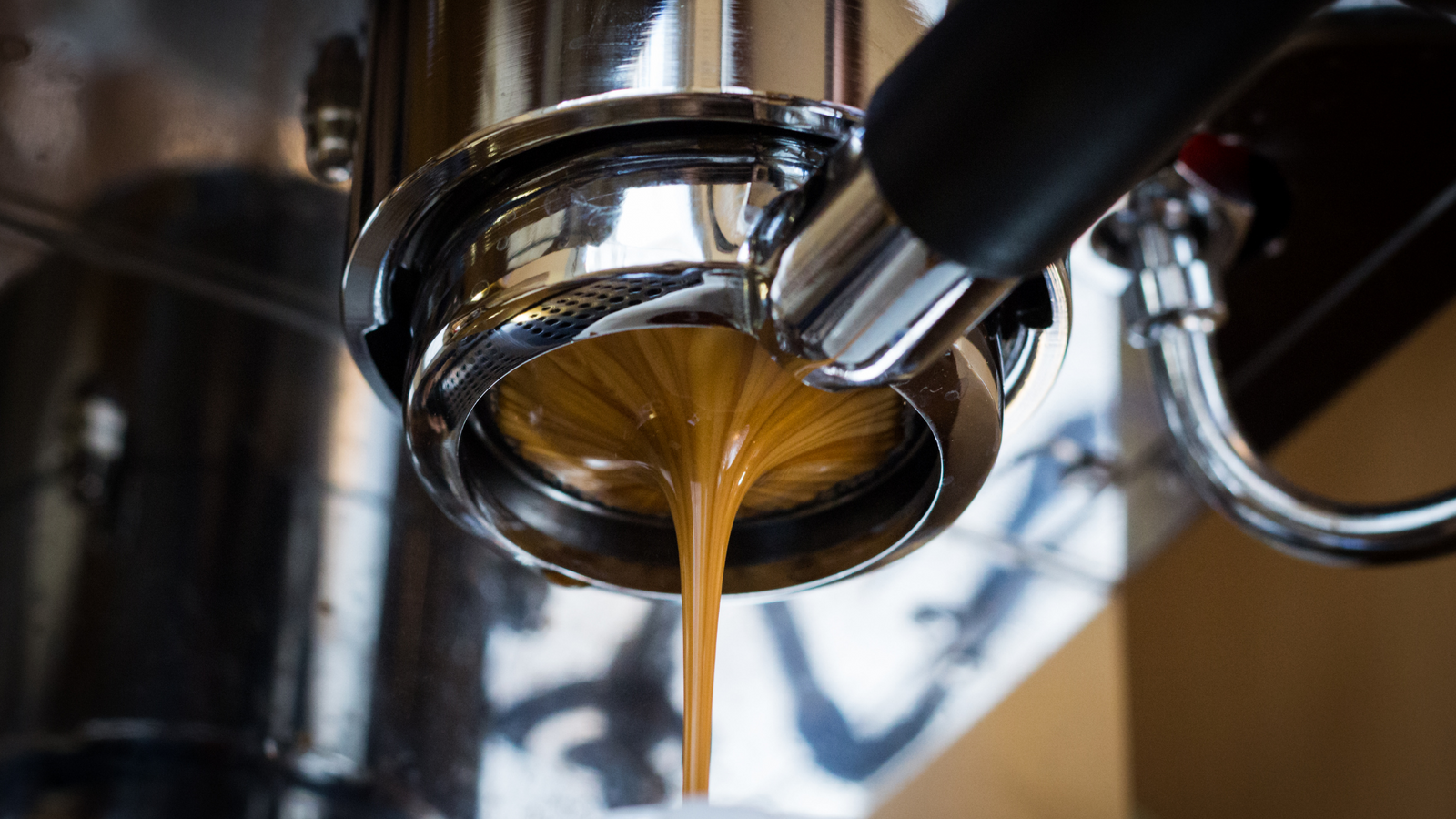
A bottomless — or naked — portafilter has the spouts and the base cut away, so you watch espresso emerge directly from the underside of the basket.
It does two things, and only one of them is about taste.
It shows you your mistakes. This is the real reason to own one. With a standard spouted portafilter, the shot is hidden until it comes out the bottom, already mixed. With a bottomless you see channelling as it happens — jets spraying sideways, one area running fast, the stream splitting instead of joining into a single tapering cone. That's immediate feedback on your grind, your distribution and your tamp, and it is by far the fastest way to improve as a home barista. Nothing else tells you this much this quickly.
It slightly improves the shot. Less metal for the espresso to travel through means marginally less heat loss and no spout to strip crema. Real, but small — don't buy one expecting a transformation in the cup.
The trade-off is mess. Until your technique is sound, a bottomless portafilter will spray. Plan on wiping the machine down for the first week.
What to look for
Get the size right. Covered above, and worth repeating because it's the mistake everyone makes.
Check the ears. The lugs that lock into the group need to be machined cleanly. Cheap ones bind, sit at an odd angle, or wear the group gasket unevenly. This is where budget portafilters fail first, and it's the one thing you can't fix later.
Stainless steel, not chrome-plated pot metal. Chrome plating flakes with heat cycling, and you don't want that near your coffee.
Match the basket. Some bottomless portafilters ship with a basket, some don't, and not all baskets fit all portafilters. Confirm before you buy or you'll need a second order.
Weight is a preference, not a spec. Heavier portafilters hold heat marginally better and feel more substantial. Wooden handles look good and stay cool. Neither changes what's in the cup.
Be sceptical of unbranded listings with no machining detail and stock photography. The ears are precision parts, and that's not visible in a photo.
If you have a 58mm machine
This is the range we stock, and it's a good one.
- Rocket Espresso Bottomless Portafilter — $79.95. Straight stainless, properly machined, from a manufacturer that has been making group heads for decades. The sensible default.
- Lelit 58mm Bottomless Portafilter — $99.95. Available in maple, walnut, zebrano, black wood and white ash. If you own a Lelit, the wood matches the knobs and paddle on your machine.
See all our bottomless portafilters
And if you're on a Breville now but thinking about a machine that opens up the whole 58mm accessory ecosystem, that's worth reading about in our guide to espresso machines for beginners — the accessory range is one of the quieter reasons people move to a prosumer machine.
Frequently asked questions
What size portafilter does a Breville Barista Express use?
54mm. So do the Bambino Plus, Barista Pro, Barista Touch, Infuser and Duo-Temp Pro. Only Breville's flagship machines — the Dual Boiler, Oracle and Oracle Jet — use the industry-standard 58mm.
Will a 58mm bottomless portafilter fit my Breville?
Only if you own a Dual Boiler, Oracle or Oracle Jet. On every other Breville it will not fit, and there is no adapter. Check your model before ordering.
Is a bottomless portafilter worth it?
Yes, if you want to improve. It shows you channelling as it happens, which is the fastest feedback available on grind, distribution and tamping. The improvement to the shot itself is small — the improvement to your technique is not.
Why does my bottomless portafilter spray everywhere?
That's channelling, and the portafilter isn't causing it — it's revealing it. Water is finding a path of least resistance through the puck instead of saturating it evenly. Usual causes are uneven distribution before tamping, an off-level tamp, or a grind that's too coarse. A spouted portafilter hides all of this.
Do I need a special basket?
Not necessarily, but check. Some bottomless portafilters include one and some don't, and basket dimensions vary between manufacturers. Confirm compatibility before ordering rather than after.
Do you sell 54mm bottomless portafilters?
No. Our range is 58mm, for the Lelit, Rocket and LUCCA machines we carry. We'd rather say that plainly than send you somewhere else with a commission attached.
The short version
Check your model, buy 54mm for almost any Breville, and pay attention to the machining on the ears rather than the wood on the handle. Then expect to make a mess for a week and learn more about espresso in that week than in the previous year.
Questions about machines, grinders or what fits what? Call us at 800-410-8867. No script, no upsell — and we'll tell you when we don't have what you need.
— Matthew D., Founder, Cliff & Pebble