

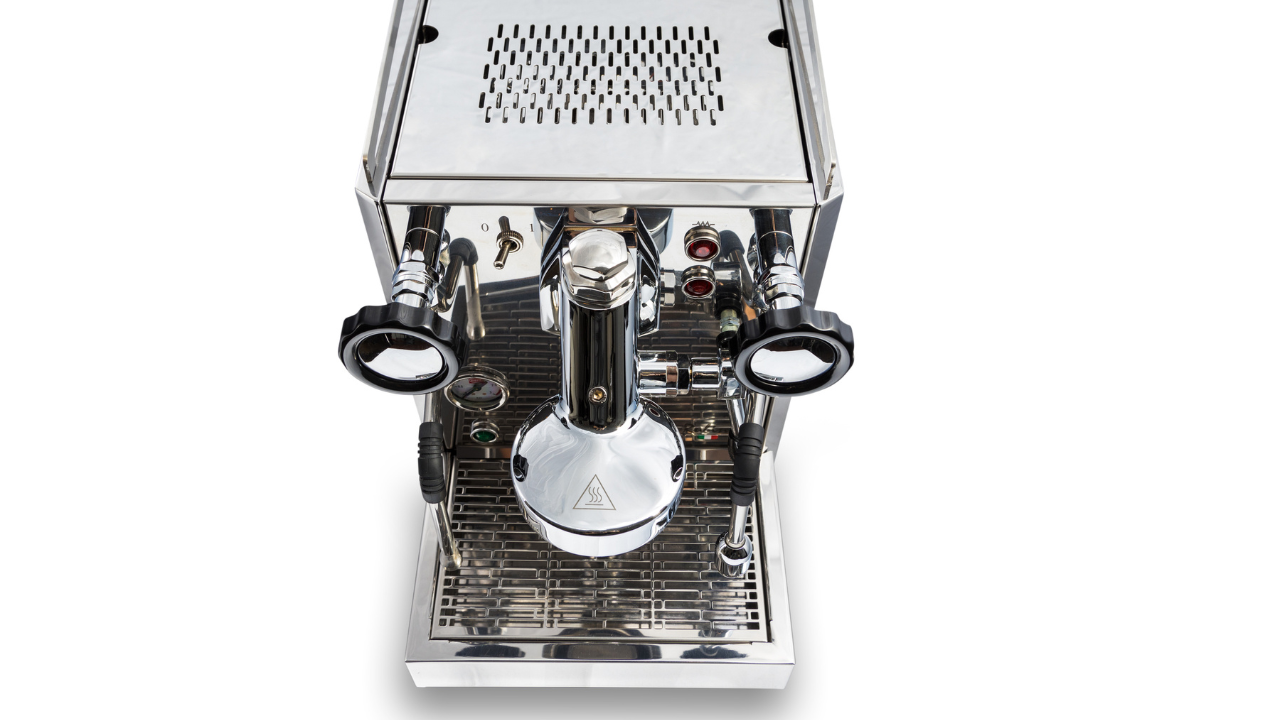
The E61 is a 65-year-old design that is still the default on serious espresso machines, and the reason is not nostalgia. It solves temperature stability passively — no electronics, no sensors — by circulating water continuously between the boiler and the group. Cheaper approaches need a computer to do the same job, and more modern ones do it better but cost more.
If you want the short version: a Turin Gallatin V HX ($1,249) is the cheapest way into an E61 machine we would stand behind. The Lelit Mara X V2 ($1,699.95) is the one most people should buy.
What Is the E61 Group Head?
The E61 group head is a brew group component made from heavy-duty chrome-plated brass. Its most important function is to stabilize temperature during espresso extraction.
Key features include:
- Thermosyphon system for thermal stability
- Pre-infusion mechanism for gentler extraction
- Robust, commercial-grade design
It was introduced in 1961 by the Italian manufacturer Faema, named for the solar eclipse of that year, and it is used today by Lelit, Rocket, LUCCA, Turin and most of the prosumer market.
Why the E61 Group Head Still Matters
1. Thermal Stability
The E61 is designed with a continuous thermosyphon loop. This circulates hot water between the boiler and group head, keeping the brew path at a consistent temperature — essential for consistent espresso.
The clever part is that it is passive. Hot water rises, cooler water sinks, and the loop runs on that alone. Nothing to fail, nothing to calibrate.
2. Passive Pre-Infusion
The E61 group head incorporates a mechanical pre-infusion feature, which gently wets the coffee puck before full pressure is applied. This reduces channeling and improves shot uniformity.
3. Durability and Serviceability
Made of solid brass and used commercially for decades, the E61 is built to last. Replacement parts are widely available and servicing is relatively simple.
This is underrated when you are spending $2,000 on a machine. A group gasket is a $10 part you replace yourself every year or two, and there is a repair guide for anything that goes wrong because thousands of people have had the same problem since 1961.
4. Wide Ecosystem of Accessories
From flow control kits to wooden knobs and portafilters, E61 machines can be upgraded and customized easily. Nearly all of them use the 58mm portafilter standard, so every basket, tamper and distribution tool on the market fits.
5. Workflow Consistency
Because so many machines share the E61 design, your experience and workflow remain consistent as you upgrade — and guides, accessories, and advice are abundant.
E61 vs saturated vs thermoblock
This is the comparison that actually decides your purchase, so here it is properly.
| E61 | Saturated | Thermoblock | |
|---|---|---|---|
| How it stabilises | Passive thermosyphon loop | Group is part of the boiler | Heats water on demand |
| Warm-up | 20–30 minutes | 20–30 minutes | Seconds |
| Temperature accuracy | Very good | Best | Adequate |
| Pre-infusion | Built in, mechanical | Programmable, if fitted | Usually none |
| Parts and service | Universal, cheap | Manufacturer-specific | Often unserviceable |
| Portafilter | 58mm standard | Often 53mm | 54mm or 58mm |
Saturated groups make the group head part of the boiler itself, so there is no loop and no temperature gradient between the two — the group simply is the boiler temperature. It is the more accurate design, it is more compact, and it is what you find on the LUCCA A53 Mini V2 ($2,595) and the Rocket R NINE ONE ($6,990). The trade is a smaller accessory ecosystem and parts that come from one manufacturer rather than the whole industry.
Thermoblocks heat water as it passes through, which is why a Breville Bambino is ready in three seconds and an E61 machine needs half an hour. They are less precise shot to shot and they do not pre-infuse, but for one or two drinks a day that matters far less than the half hour does.
The honest summary: saturated is technically better and costs more, thermoblock is faster and less precise, and E61 sits in the middle with the best parts availability of the three. None of them is wrong.
The best E61 espresso machines we stock
Cheapest way in — Turin Gallatin V HX, $1,249

E61-style group, heat exchanger boiler, full PID, 58mm portafilter and a three-hole steam tip. Brews and steams simultaneously.
This is the entry point to the E61 ecosystem and it is our own house brand, which means we know what is inside it and we stock the parts.
Best for most people — Lelit Mara X V2, $1,699.95

Compact E61 machine with a heat exchanger boiler and dual PID that manages its own thermal behaviour rather than making you learn to cool-flush it.
Cool-flushing was the thing that made older heat exchangers annoying, and the Mara X is the machine that fixed it. It is also quiet, which people underrate until the machine lives in an open-plan kitchen.
Best E61 dual boiler under $2,000 — Turin Gallatin Dual Boiler, $1,949

Two boilers, full PID on both, E61 group, 58mm portafilter. Brew and steam at once with independent temperature control on each.
Best build — LUCCA M58 Sunto, $2,995

E61 group, 58mm, and the fit and finish that the price implies. A flow control version is available at $3,095 if you want to shape the shot.
Best for control — Lelit Bianca V3, $2,999.95

E61 with a manual paddle for flow and pressure profiling, true dual boiler, dual PID, and a repositionable water tank.
The paddle is the purest expression of what the E61 ecosystem allows: a mechanical modification to a 1961 design that gives you control most machines cannot offer at any price.
Also worth knowing
The LUCCA Solo ($1,395) is an E61 single boiler, and there is a flow control version at $1,495 — unusual at that price. At the top, the Rocket Bicocca ($5,790).
Living with an E61
The E61 has been in production since 1961, and the reason it's still here is that it's serviceable. Parts are available, the design is documented, and nothing inside it is a sealed module you have to replace whole. That's the trade for the warm-up time — you get a group head you can actually maintain rather than one you replace.
Where the E61 came from
Faema introduced the E61 in 1961. The name comes from the total solar eclipse of February that year — "E" for eclipse, 61 for the year — and the design was a genuine leap: it brought thermosiphon circulation and a motorized pump to a market that had been running on spring levers. Sixty-five years later, the group on a new Lelit or LUCCA is recognizably the same object. Very little in consumer hardware survives that long without changing.
Cleaning your E61
- Flush after every use. A short flush of hot water clears coffee oils and grounds before they set.
- Pull the portafilter and basket so you can reach the group face.
- Wipe and scrub. A damp cloth on the group face, shower screen, and gasket. A soft brush for anything stubborn — never anything abrasive.
- Soak periodically. Portafilter and basket into a solution of water and espresso machine detergent. Follow the dilution and timing on the product.
- Backflush. Blind basket in the portafilter, cleaning tablet or powder, run your machine's backflush routine. Weekly is a reasonable default for daily drinkers.
- Rinse thoroughly so no detergent stays behind — you will taste it if it does.
- Reassemble and pull a throwaway shot before you make anything you plan to drink.
Routine maintenance
- Gaskets and seals. Inspect the group gasket regularly. A hardened or compressed gasket is the most common cause of a leaking group and the cheapest thing to replace. If the portafilter is sitting noticeably further around than it used to, the gasket is done.
- Descaling. Mineral scale builds up in the thermosiphon and kills the E61's main advantage — its temperature stability. Frequency depends entirely on your water, which is why what you put in the tank matters more than most people think.
- Lubrication. Food-grade lubricant on the lever mechanism keeps the action smooth and prevents wear. This is routine service, not a repair.
Troubleshooting
| Symptom | Usual cause | Fix |
|---|---|---|
| Group head leaking | Worn or hardened group gasket | Replace the gasket |
| Temperature swinging | Scale in the thermosiphon | Descale, then reconsider your water |
| Water not spreading evenly | Clogged shower screen, or a warped basket | Clean the screen; check the basket for damage |
| Lever stiff or sticky | Dry lever mechanism | Lubricate — don't force it |
If none of that resolves it, call us at 800-410-8867. We service what we sell, and most E61 complaints turn out to be a $5 gasket.
Is the E61 Group Head Right for You?
Choose an E61-based machine if you:
- Want stable, barista-quality espresso at home
- Appreciate the ability to customize and upgrade your machine
- Prefer a workflow that mirrors commercial setups
- Value longevity, consistency, and a time-tested system
Skip the E61 if you:
- Need fast heat-up with no wait — a thermoblock machine is ready in seconds
- Prefer full automation and volumetric dosing
- Want the smallest possible machine footprint
The thing that catches people out
An E61 group is a heavy lump of brass, and it needs 20 to 30 minutes to come up to temperature — the boiler gets there long before the group does. A machine that says it is ready after five minutes will still pull a thin, sour shot. Put it on a timer or a smart plug and the problem disappears.
Questions we get
What is an E61 group head?
A brew group made of chrome-plated brass, introduced by Faema in 1961, that stabilises brew temperature using a passive thermosyphon loop circulating water between the boiler and the group. It also provides mechanical pre-infusion.
Is the E61 group head still worth it?
Yes, for most buyers. It is not the most accurate design available, but it has the best parts availability and the widest accessory ecosystem of any group head, and a well-maintained E61 machine lasts decades.
What is the difference between an E61 and a saturated group head?
An E61 circulates water to the group through a thermosyphon loop. A saturated group is physically part of the boiler, so it sits at boiler temperature with no loop. Saturated is slightly more accurate and more compact; E61 has far better parts availability and usually a 58mm portafilter.
How long does an E61 machine take to warm up?
20 to 30 minutes. The boiler reaches temperature much sooner, but the brass group head is what takes the time, and pulling a shot before it is ready gives you a thin, sour result.
What is the cheapest E61 espresso machine?
Of the ones we stock, the Turin Gallatin V HX at $1,249. The LUCCA Solo at $1,395 is an E61 single boiler if you want a simpler machine.
Do all E61 machines use a 58mm portafilter?
Nearly all of them, which is one of the main practical advantages. 58mm is the commercial standard, so baskets, tampers and distribution tools from any brand will fit.
Can you add flow control to an E61 machine?
On many of them, yes — it is one of the reasons the design has lasted. Some machines ship with it, like the Lelit Bianca V3, and others accept a kit. Call us before buying a kit; fit varies by model.
Final thoughts
The E61 remains one of the most functional components in espresso. It is not the newest and it is not the most accurate — a saturated group beats it on paper. What it has is sixty-five years of parts, accessories, modifications and accumulated knowledge, and a design simple enough that it keeps working.
If you value consistency, upgradeability and being able to fix your own machine in ten years, an E61 is still one of the smartest buys in espresso.
Call 800-410-8867 and tell us what you drink and how many drinks you make in a row. We would rather talk you into the cheaper right machine than the more impressive wrong one.