

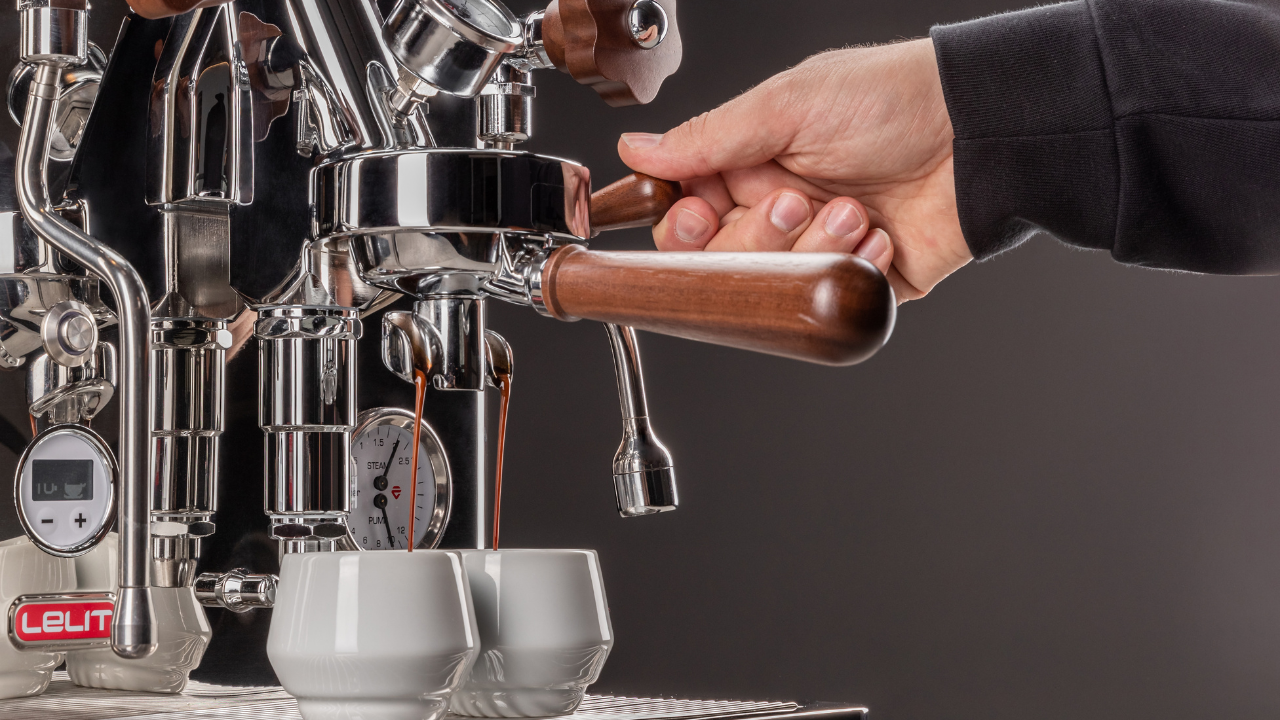
It is worth it if you make more than one milk drink in a row. That is the whole test, and it is not really about espresso quality — it is about not standing at the machine waiting for a boiler to change temperature while the first drink goes cold.
If you drink one cappuccino a morning, or you drink espresso black, a dual boiler is a real machine solving a problem you do not have. A heat exchanger costs less and does the same job for milk.
What a dual boiler actually is
A dual boiler machine has two separate boilers:
- One for brewing espresso, held around 200°F
- One for steaming milk, held around 250°F
Because each boiler only has one job, you can brew and steam at the same moment without either temperature moving. Compare that to:
- Single boiler machines, which switch between the two temperatures — you wait 30 to 60 seconds each way
- Heat exchangers, which run one boiler hot enough for steam and pass brew water through a tube inside it, arriving at brew temperature on the way to the group
The distinction that matters: a heat exchanger also brews and steams simultaneously. What it does not give you is independent control of the brew temperature. That is the actual thing a second boiler buys, and whether it is worth the money depends entirely on whether you would use it.
The honest test
Buy a dual boiler if:
- You make two or more milk drinks back to back, most days
- You want to change brew temperature deliberately and taste the result
- You are entertaining regularly, or there are two coffee drinkers in the house
- You buy light roasts, which are sensitive enough to brew temperature that the control earns its keep
Do not buy one if:
- You drink one or two drinks a day and do not mind a short wait
- You drink espresso black and do not steam milk at all
- You are buying your first machine — a dual boiler solves problems you have not met yet
- Buying one would mean skimping on the grinder. That trade is always wrong.
The cheaper right answer
A heat exchanger like the Lelit Mara X V2 ($1,699.95) steams and brews at the same time for less than most dual boilers, and for milk drinks it does the job just as well. The second boiler is about the espresso, not the milk. We would rather sell you the HX and have you happy with it.
The best dual boiler espresso machines
Every machine here is one we stock, with the price we are charging today.
Best value — Lelit Elizabeth V3, $1,799

Two boilers at a price most brands want for one. PID on both, programmable pre-infusion, shot timer, and a footprint small enough for a normal kitchen.
This is the cheapest genuine dual boiler we would recommend, and the one that makes the category make sense. Below this price you are buying the words rather than the benefit.
Best traditional build — Turin Gallatin Dual Boiler, $1,949

58mm portafilter, E61 group head, full PID on both boilers, and simultaneous brewing and steaming with minimal compromise.
The 58mm size matters more than it sounds: it is the commercial standard, so every basket, tamper and distribution tool on the market fits. This is our own house brand, which means we know what is inside it and we stock the parts.
Best for milk drinks — LUCCA A53 Mini V2, $2,595

Dual brass boilers, a saturated 53mm group, volumetric dosing and a front-loading water reservoir.
The volumetric dosing is why it sits here. You program the shot volume and press a button, and the machine stops itself. When you are making four drinks and steaming between them, not watching a scale for every shot is the difference between a pleasant twenty minutes and a stressful one. The front-loading reservoir is the same kind of thinking — you refill it without pulling the machine out from under the cabinets.
Best for control — Lelit Bianca V3, $2,999.95

Dual boiler with a manual paddle for flow and pressure profiling, dual PID, an E61 group, and a repositionable water tank.
The paddle is the point. It lets you shape the pressure across the shot rather than accepting one curve, and on a light roast that is a genuinely different cup. It is also the feature people buy and never use, so be honest with yourself: if you want a dual boiler for milk drinks, the A53 Mini does that part as well for $400 less. We put the two head to head if you are weighing exactly this.
The rest of the range
Hands-off: the Breville Barista Touch Impress ($1,499) and Breville Oracle Jet ($1,999.95) both grind, tamp and steam from a touchscreen. Legitimate choices if you want excellent coffee without the craft.
Above $3,000: the LUCCA M58 Sunto ($2,995), A53 Direct Plumb ($2,995) if you want to plumb it in, A53 Pro ($3,495), and at the top the Rocket Bicocca ($5,790) and R NINE ONE ($6,990).
See every dual boiler we stock →
What a dual boiler does not fix
A bad grinder. The machine can only work with the coffee bed it is given. Temperature stability operates on the puck the grinder made, and if that puck has fines clumped against boulders the water will channel through it regardless. Spend at least 40% of your total budget on the grinder — the reasoning is in our grinder guide, and the matcher will name one in four questions.
Bad water. Two boilers means twice as much metal for scale to form on, and the steam boiler runs hotter, which is where scale forms fastest. A $3,000 dual boiler on untreated hard water is a more expensive mistake than a $500 machine on the same water. Check where your water sits before you buy anything on this page.
Stale coffee. No machine recovers beans roasted four months ago.
Questions we get
Is a dual boiler espresso machine worth it?
Yes, if you make two or more milk drinks back to back most days, or you want independent control of brew temperature. No, if you drink one or two drinks a day, drink espresso black, or would have to spend less on the grinder to afford it.
What is the difference between a dual boiler and a heat exchanger?
Both brew and steam at the same time. A heat exchanger does it with one boiler and internal piping; a dual boiler uses two separate boilers, which adds independent control of the brew temperature. For milk drinks alone, a heat exchanger does the job for less money.
What is the cheapest good dual boiler espresso machine?
The Lelit Elizabeth V3 at $1,799. It has PID on both boilers, programmable pre-infusion and a compact footprint. Below roughly this price you are buying the label rather than the benefit.
Do I need a dual boiler for latte art?
No. Steam power and wand design matter for milk texture, not boiler count, and plenty of heat exchangers steam as well as dual boilers do. What a dual boiler gives you is not having to wait between the shot and the milk.
Is a dual boiler worth it for a beginner?
Usually not. A dual boiler solves workflow problems you have not encountered yet, and the money is better spent on a good grinder and a simpler machine. Buy one when the wait on your current machine genuinely annoys you.
How long does a dual boiler take to heat up?
Typically 20 to 30 minutes to bring both boilers and the group head to temperature. Many models can be put on a timer or a smart plug so the machine is ready when you are.
Are dual boiler machines harder to maintain?
Slightly, because there is more of everything. The bigger factor is water: two boilers means twice as much surface for scale, and the steam boiler runs hottest. Treated water matters more on a dual boiler than on anything else.
The short answer
A dual boiler is worth it when you are making several milk drinks in a row, or when you want to control brew temperature on purpose. It is not worth it as a first machine, and it is never worth it if paying for it means buying a worse grinder.
If that is you: the Elizabeth V3 at $1,799 is where the category starts making sense, the A53 Mini at $2,595 is the best of them for milk, and the Bianca V3 at $2,999.95 if you want to shape the shot.
If you are not sure, call 800-410-8867 and tell us how many drinks you make in a row. That one number answers most of this, and we would rather talk you into the cheaper right machine than the more impressive wrong one.