

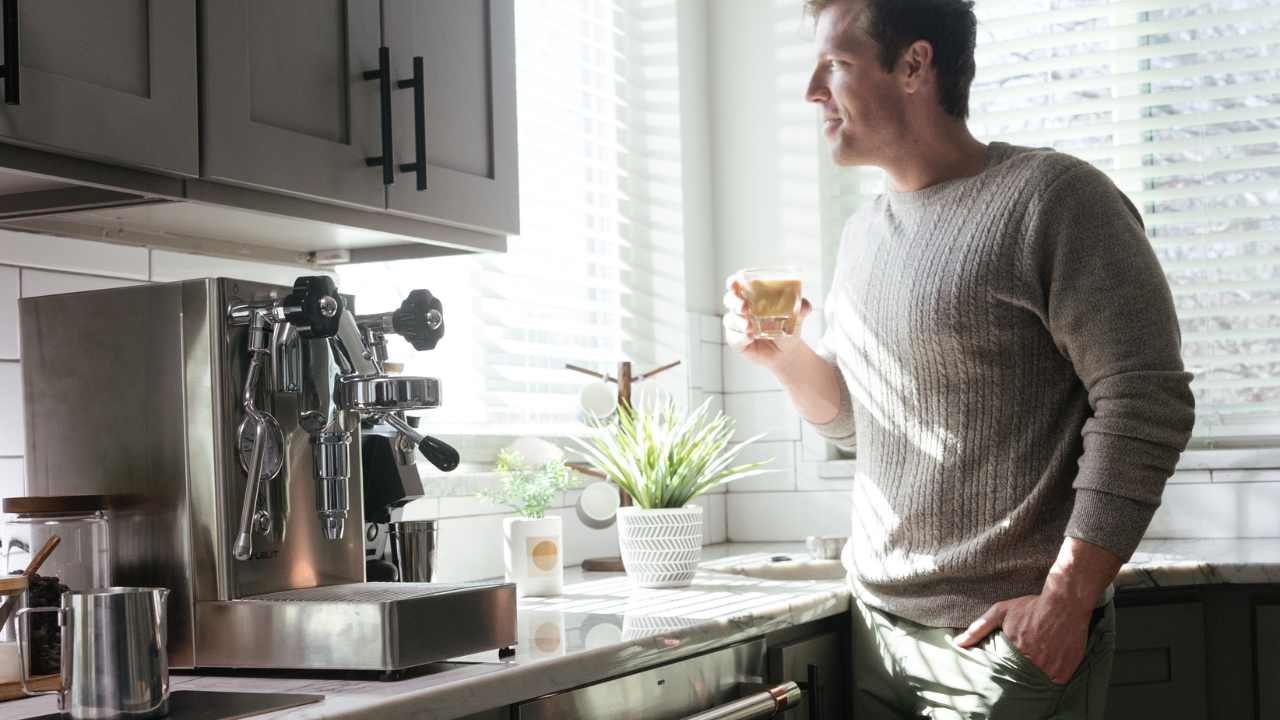
Most espresso machines need 20 to 30 minutes, not the five the power light suggests. The boiler gets to temperature quickly; the brass group head is what takes the time, and pulling a shot before it is ready gives you a thin, sour result no matter how good the machine is.
Thermoblock machines like the Breville Bambino Plus are the exception — they are genuinely ready in seconds. Everything with an E61 group needs the full half hour.
Warm-up time by machine
Times are to a stable group head, not to the power light. Every machine below is one we stock.
| Machine | Type | Warm-up | Price |
|---|---|---|---|
| Breville Bambino Plus | Thermoblock | Under 1 min | $499.95 |
| Barista Express Impress | Thermoblock | 1–3 min | $799.95 |
| Turin Legato V2 | Single boiler | 5–10 min | $479 |
| Lelit Victoria | Single boiler | 5–10 min | $999.95 |
| Breville Oracle Jet | Dual boiler, thermoblock-assisted | 3–5 min | $1,999.95 |
| Turin Gallatin V HX | Heat exchanger, E61 | 15–20 min | $1,249 |
| LUCCA Solo | Single boiler, E61 | 20–25 min | $1,395 |
| Lelit Mara X V2 | Heat exchanger, E61 | 15–20 min | $1,699.95 |
| Lelit Elizabeth V3 | Dual boiler | 15–20 min | $1,799 |
| Turin Gallatin Dual Boiler | Dual boiler, E61 | 25–30 min | $1,949 |
| Rocket Appartamento TCA | Heat exchanger, E61 | 20–25 min | $2,250 |
| LUCCA A53 Mini V2 | Dual boiler, saturated group | 20–25 min | $2,595 |
| Lelit Bianca V3 | Dual boiler, E61 | 25–30 min | $2,999.95 |
Two things worth noticing in that table. The Elizabeth V3 is a dual boiler that heats faster than most heat exchangers, because it does not use an E61 group. And the Oracle Jet is a dual boiler that is ready in minutes, because Breville pairs the boilers with thermoblock heating.
The group head decides this, not the boiler count. An E61 is a heavy lump of chrome-plated brass, and heating it through is what you are waiting for.
Why Espresso Machine Warm-Up Time Matters
Espresso is a game of precision. Unlike drip coffee, where a few degrees here or there will not ruin the brew, espresso is sensitive — you are forcing hot water through finely ground coffee at high pressure, and small variations change the flavour.
Four things are happening while the machine warms:
- Heating the boiler. The water must reach and stabilise at brewing temperature, usually 190–205°F (88–96°C).
- Saturating the group head. The group must absorb heat so the water stays stable when it meets the coffee. A cold group instantly cools the water, which is what gives you a sour shot.
- Warming the portafilter. A cold portafilter acts like an ice cube, stealing heat from the brew. Leave it locked in during warm-up.
- Building steam pressure. For milk drinks, the steam boiler needs to reach pressure to produce dry, consistent steam.
The tell is a shot that tastes sour and thin with pale crema, on a machine that made good coffee yesterday. That is almost always an under-warmed group rather than anything you did with the grinder.
How long by machine type
Thermoblock — under 3 minutes
A thermoblock heats water on demand as it passes through, so there is no mass of metal to bring up to temperature. This is why a Bambino Plus is ready in about three seconds.
The trade is precision: thermoblocks are less consistent shot to shot than a boiler, and they do not pre-infuse. For one or two drinks a day that matters much less than the half hour does.
Single boiler — 5 to 10 minutes
One boiler that switches between brewing and steaming. Compact, efficient, quick to heat. The wait comes later instead, between pulling a shot and steaming milk.
The Turin Legato V2 ($479) and Lelit Victoria ($999.95) both sit here.
Note the exception: the LUCCA Solo is a single boiler with an E61 group, so it takes 20–25 minutes despite the simpler boiler. Again — it is the group, not the boiler.
Heat exchanger — 15 to 25 minutes
An HX brews and steams simultaneously from one boiler. Nearly all of them use an E61 group, which is where the time goes: the boiler may be hot in ten minutes but the group needs closer to twenty.
The Lelit Mara X V2 is the fastest to become usable in this class, because its dual PID manages the thermosyphon actively rather than leaving you to cool-flush.
Dual boiler — 15 to 30 minutes
Separate boilers for brewing and steaming. More metal to heat, so generally the longest wait — but it depends entirely on the group.
The Elizabeth V3 heats in 15–20 minutes without an E61. The Bianca V3 and Turin Gallatin DB both have E61 groups and want the full 25–30.
The role of the E61 group head
The E61 is why prosumer machines take so long, and it is worth understanding rather than resenting.
It is a solid block of chrome-plated brass, introduced by Faema in 1961, that stabilises brew temperature with a passive thermosyphon loop — hot water circulates continuously between the boiler and the group, driven by nothing but convection. No sensors, no electronics, nothing to fail.
The cost of that elegance is thermal mass. All that brass has to come up to temperature before it stops stealing heat from your shot, and mass heats slowly. It is a direct trade: the thing that makes an E61 stable is the same thing that makes it slow.
We wrote more on why the E61 is still the default if you want the longer version.
How to speed up warm-up
1. Use a smart plug or outlet timer
The single most effective fix, and it costs about $15. Set the machine to switch on 30 minutes before you get up and the wait disappears entirely. This is what most of our customers with E61 machines end up doing.
Check your machine's power switch behaviour first — some need the physical switch left in the on position for this to work.
2. Keep the portafilter locked in
A cold portafilter pulls heat out of the group on your first shot. Leaving it locked in during warm-up means it comes up to temperature alongside everything else. Free, and it makes a real difference to the first drink.
3. Flush the group before the first shot
A short flush pulls hot water from the boiler through the group, which both warms the brew path and clears any water that has been sitting. Two to three seconds is enough.
4. Do not skimp on the wait
The most common mistake, and the most expensive one given what the machine cost. If you have fifteen minutes rather than thirty, expect the first shot to be a throwaway and plan for it.
5. Insulate in cold rooms
If the machine lives in a cold garage or an unheated kitchen, warm-up takes noticeably longer and stability suffers. Moving it somewhere warmer does more than any adjustment you can make on the machine.
Which machine fits your morning
You want coffee within two minutes of waking up: a thermoblock machine. The Bambino Plus at $499.95, or the Oracle Jet at $1,999.95 if you want a dual boiler that still heats in minutes.
You are happy to plan ten minutes ahead: a single boiler. The Lelit Victoria at $999.95.
You will use a smart plug: anything. Once the machine is warming before you are awake, warm-up time stops being a purchase criterion at all, and you should choose on the things that matter every day instead — steam power, workflow, build. That is most people, and it is why we rarely let warm-up time drive a recommendation.
You want the fastest E61: the Lelit Mara X V2. Its PID makes it usable sooner than anything else with that group.
Frequently asked questions
How long should an espresso machine warm up?
20 to 30 minutes for anything with an E61 group head, 15 to 20 for most heat exchangers and non-E61 dual boilers, 5 to 10 for a single boiler, and under 3 minutes for a thermoblock machine. The power light is not the signal — the group head is what takes the time.
How long does the Lelit Bianca V3 take to warm up?
25 to 30 minutes. It is a dual boiler with an E61 group, which is the slowest combination. A smart plug is the standard solution and most Bianca owners use one.
How long does the Lelit Mara X take to warm up?
15 to 20 minutes. Its dual PID actively manages the thermosyphon, which makes it the fastest E61 machine to become genuinely usable.
How long does the Rocket Appartamento take to warm up?
20 to 25 minutes. E61 group and a larger boiler than most machines in its class, so it wants the longer end of the range.
Which espresso machine has the fastest warm-up time?
Of the machines we stock, the Breville Bambino Plus — ready in about three seconds because it uses a thermoblock rather than a boiler. Among dual boilers, the Breville Oracle Jet at 3 to 5 minutes.
Can I use my espresso machine before it is fully warmed up?
You can, but the shot will taste sour and thin with pale crema, because a cold group head cools the water on contact. If you are short on time, pull a throwaway shot first to warm the brew path.
Why do expensive espresso machines take longer to heat up?
Because they use more metal. An E61 group is a solid block of brass whose thermal mass is exactly what keeps the temperature stable during extraction — and mass heats slowly. The stability and the wait are the same property.
Does leaving an espresso machine on all day use much power?
A prosumer machine idles at roughly 50 to 100 watts once up to temperature, so leaving it on for a working day costs cents rather than dollars. A timer is still the better answer, for the machine as much as the bill.
The short answer
Give it 30 minutes if it has an E61 group, and buy a $15 smart plug so you never think about it again. Warm-up time is the easiest specification to design around and the one people weight most heavily when choosing a machine — which is backwards.
Not sure which machine suits how you actually drink coffee? Call 800-410-8867 and describe your morning. We would rather talk you into the cheaper right machine than the more impressive wrong one.