

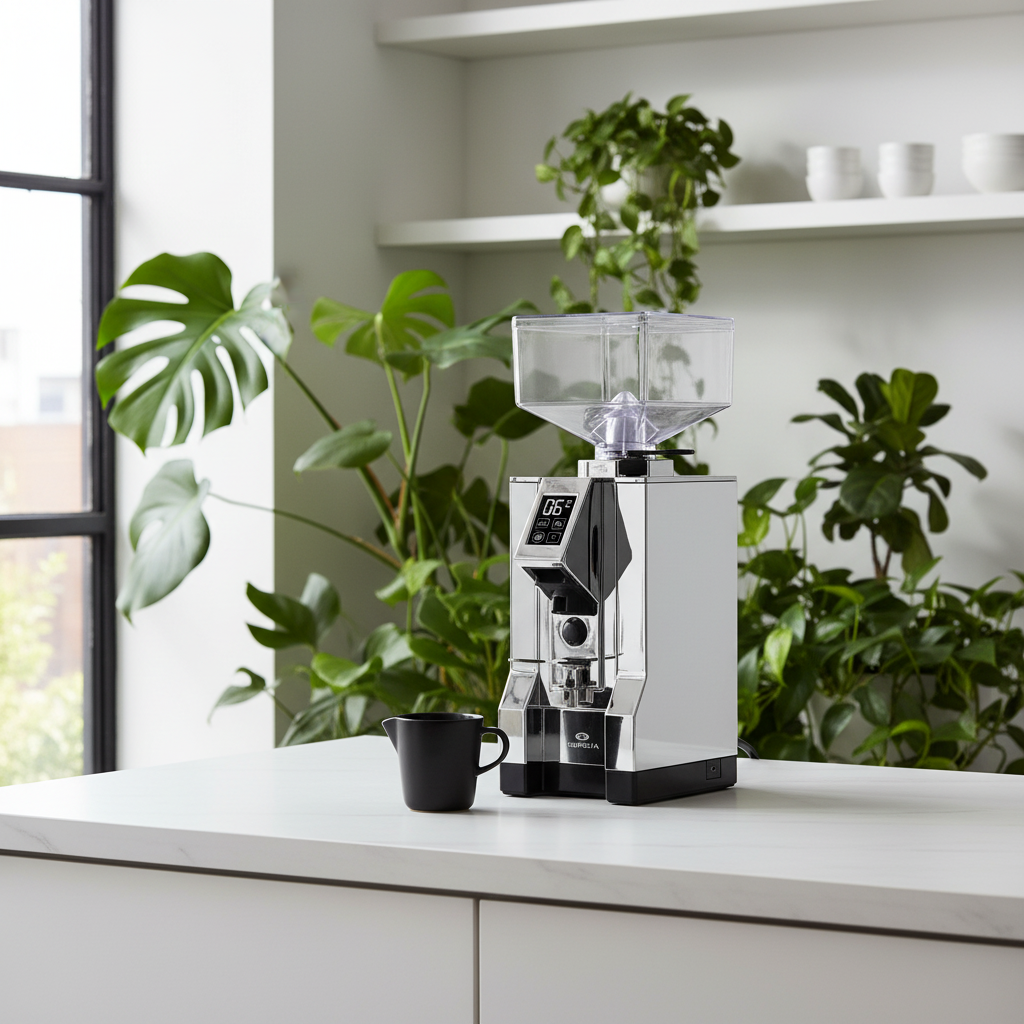
We sell the Eureka Mignon Specialita. We don't sell the Niche Zero. We've tried to write this the way we'd say it on the phone, including the parts that don't help us.
The short version: the Niche Zero is the better single-dosing grinder. The Specialita is the better everyday grinder. If you grind one dose at a time, weigh your beans and chase clarity, take the Niche. If you want to press a button and get 18 grams without thinking about it, take the Specialita.
The specs side by side
| Mignon Specialita | Niche Zero | |
|---|---|---|
| Burrs | 55mm flat steel | 63mm conical |
| Designed for | Hopper, timed dosing | Single dosing |
| Dosing | Electronic, 2 presets | Manual, weigh-in |
| Adjustment | Stepless, micrometric | Stepless, numbered dial |
| Retention | Low, not zero | Near zero |
| Price | $649 | ~$629 direct from Niche |
| US availability | In stock, ships now | Direct from the UK |
Flat vs. conical, without the hedging
Most comparisons say "it comes down to preference" and stop. That's true but useless. Here's what actually differs.
Flat burrs produce a narrower particle size distribution. Grounds come out closer to the same size as each other. In the cup that tends to read as clarity — individual flavors separated out, brighter acidity, a cleaner finish. It flatters light and medium roasts and single origins where you want to taste the specific coffee.
Conical burrs produce a wider distribution — more fines and more large particles in the same dose. That sounds like a flaw and isn't. The varied extraction rates give you more body, a rounder, heavier texture, and a more forgiving shot. It flatters darker roasts, blends and milk drinks.
Neither is better. They're different flavors of correct, and if you've only ever used one you probably don't have a preference yet.
What's worth keeping in perspective: at the home scale, the gap between a good flat grinder and a good conical grinder is smaller than the gap between either one and the grinder most people are upgrading from. Don't agonize over burr geometry if you're coming off a blade grinder or a Breville's built-in.
Retention — and a correction

This gets explained backwards constantly, including in the older version of this post, so let's be precise.
Retention is how much ground coffee stays inside the grinder instead of coming out. Low retention is good. High retention is bad. "Excellent retention" is not a compliment — it means the grinder is keeping your coffee.
Why it matters: if 1.5 grams stay behind, you put 18g in and get 16.5g out, so your ratio is wrong before you start. Worse, those 1.5g come out tomorrow, stale, mixed into the front of the next dose.
This is the Niche Zero's headline achievement. The grind path is short and near-vertical, and retention is effectively nil — what goes in comes out, the same morning. That's the actual reason it developed the following it has, more than the 63mm burrs.
The Specialita is low-retention, not zero-retention. It was designed around a hopper, with a chute the grounds have to travel. Used as intended — beans in the hopper, press for your programmed dose — retention is irrelevant, because there's always more coffee behind what's leaving. Used as a single-doser without modification, you'll notice it.
And to correct another common mix-up: grounds spraying across the counter is static, not retention. A spritz of water on the beans before grinding fixes most of that on any grinder.
Electronic dosing vs. weighing every time
This is the real daily difference, more than burrs.
The Specialita has a timed electronic dose with two programmable presets, adjustable to a hundredth of a second — one for a single, one for a double. Beans live in the hopper. Press the button, walk away, come back to your dose. For someone making the same drink every morning, this is genuinely better, and it's the feature people underrate until they own it.
The limitation is that timed dosing drifts. As beans age and change density, the same three seconds yields slightly different grams, so you re-check on the scale every so often.
The Niche is weigh-and-pour. You put beans on a scale, tip them in, grind, and everything that went in comes out. It's more accurate by definition and it's a step you do every single time. If you switch between coffees often, that's a feature. If you drink the same beans daily, it's a chore.
Can you single dose the Specialita?
Yes, with caveats. Any grinder can be fed one dose at a time. The Specialita wasn't engineered for it — without a bellows or hopper modification you'll get retention and a slightly slower, messier workflow. Kits run around $50 and work well.
But buying a grinder designed for one workflow and modifying it into another is usually the wrong call. If single dosing is the point, buy a single doser.
We went through this in detail in single dosing with the Specialita.
The option neither of these is
If you've read this far because you want conical burrs and true single dosing, the honest answer is that you don't have to import one.
The Turin DC63 at $398 is a 63mm conical single-dose grinder — the same burr geometry and the same workflow as the Niche, for roughly $230 less, in stock, shipping from the US with a warranty you can actually claim. It doesn't have the Niche's fit and finish or its reputation, and we'd tell you that up front. It grinds the same way.
If you'd rather have flat burrs and single dosing, the Turin DF64 Gen 2.7 at $354 is the volume seller in that category.
And if the Specialita's price is the sticking point rather than the format, the Eureka Mignon Zero at $329 is the same family with a single-dose design.
Price and getting hold of one
The Specialita is $649 and ships from us. Chrome and specialty finishes carry a premium.
The Niche Zero runs around $629 and is sold direct by Niche in the UK. Availability has improved a lot since the years when it had a genuine waiting list, but you're still buying from overseas — which shapes shipping, duties and what happens if something goes wrong in year two. Niche also now makes the Duo, a flat-burr sibling, if you like the format but want flat burrs.
What we'd actually tell you on the phone
Buy the Specialita if you drink the same coffee most days, you want to press a button rather than weigh beans, and you'd like one grinder that also handles pour-over and French press competently.
Buy the Niche Zero if single dosing is the whole point, you rotate through different beans, and zero retention matters more to you than convenience.
Buy the DC63 if you want what the Niche does, sooner and for less, and you don't need the badge.
Frequently asked questions
Is the Niche Zero better than the Eureka Specialita?
For single dosing, yes — near-zero retention and a workflow built around one dose at a time. For everyday use with a hopper and programmed doses, the Specialita is more convenient and handles brew methods beyond espresso more consistently. They're built for different habits rather than being better or worse.
Are flat burrs better than conical burrs?
No, they're different. Flat burrs give a narrower particle distribution, which tends to read as clarity and brighter acidity. Conical burrs give a wider distribution, which tends to read as more body and a rounder, more forgiving shot. Roast and personal taste decide which suits you.
What does grinder retention mean?
How much ground coffee stays inside the grinder rather than coming out. Low retention is good — you get back what you put in, and no stale grounds carry over into tomorrow's dose. The Niche Zero's retention is effectively nil; the Specialita's is low but not zero, because it was designed around a hopper.
Can you single dose with a Eureka Mignon Specialita?
Yes, though it wasn't designed for it. Without a bellows or hopper modification you'll see some retention and a slightly messier workflow. Kits cost around $50. If single dosing is your main reason for buying, a purpose-built single doser is the better buy.
How much is the Eureka Mignon Specialita?
$649 from us, in stock and shipping from the US. Chrome and specialty finishes cost more.
Is there a cheaper alternative to the Niche Zero?
The Turin DC63 at $398 uses the same 63mm conical format and the same single-dose workflow, ships from the US, and costs around $230 less. It doesn't match the Niche on fit and finish, but it grinds the same way.
Which grinder is better for pour-over and French press?
The Specialita. We've found consistency drops off on the Niche at coarser settings, while the Specialita holds up better across brew methods. If espresso is only part of what you make, that matters.
The short version
Niche for single dosing and zero retention. Specialita for press-a-button convenience and better coarse grinding. Burr shape is a flavor preference, not a ranking — and if you want the Niche's format without the wait or the import, the DC63 does it for $398.
Still torn? Call us at 800-410-8867. Tell us what you drink and how you'd rather spend your mornings.