

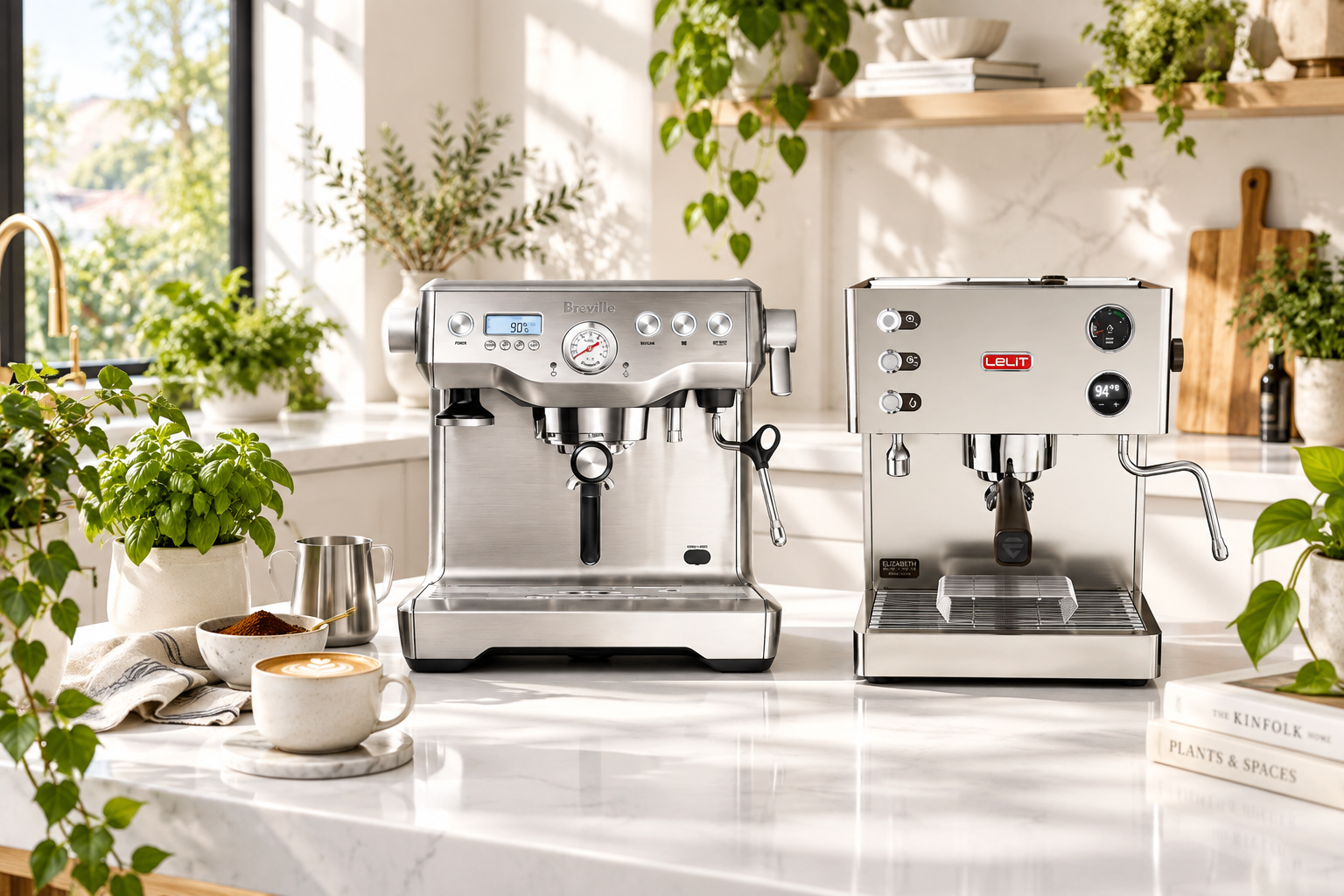
We sell the Lelit Elizabeth. We don't sell the Breville Dual Boiler. Read the conclusion with that in mind — we've tried to be straight about where the Breville is the better buy.
These two are genuine competitors: both are true dual boilers, both take a 58mm portafilter, neither has a built-in grinder, and they're roughly $200 apart. The decision usually comes down to three things that have nothing to do with the spec sheet.
The short answer
Breville Dual Boiler if you want more automation out of the box, you're comfortable in the Breville ecosystem, and counter space isn't tight.
Lelit Elizabeth V3 if you want a machine you'll still be repairing in fifteen years, you value a compact footprint, and you'd rather call a dealer than a corporate support line.
What they actually share
More than most comparisons admit. Both give you:
- Two real boilers — separate brew and steam, so you can pull and steam simultaneously with independent temperature control
- PID on both, so you set brew temperature directly rather than inferring it from boiler pressure
- Programmable pre-infusion to saturate the puck before full pressure
- A commercial 58mm portafilter, which means every basket, tamper and distribution tool on the market fits
- Shot volume programming and a pressure gauge
If your question is "which makes better espresso," the honest answer is that a competent person will pull indistinguishable shots on either. The differences are about living with them.
The three things that actually decide it

Footprint
This is the most underrated difference and the one people regret ignoring.
The Elizabeth is 9.6 inches wide. The Breville Dual Boiler is over 16. That is not a rounding error — it's the difference between fitting under a wall cabinet beside your kettle and having to rearrange the kitchen.
If you've measured your counter and it's tight, this decides the question before anything else does.
Automation vs. control
Breville builds for convenience. The Dual Boiler has more automated routines out of the box — auto-purge after steaming, straightforward volumetric programming, an interface designed to be understood without reading anything. If you want to press buttons and get coffee, that's a genuine advantage, and Breville is very good at it.
Lelit builds for control. The Elizabeth's OLED display and Lelit Control Center expose more parameters — brew and steam temperatures set independently, programmable pre-infusion timing, adjustable pump behavior. It rewards someone who wants to tune, and it asks a bit more of you at the start.
Neither approach is better. They're aimed at different people, and you probably already know which one you are.
What happens in year six
This is where they diverge most, and it's the thing spec tables never capture.
The Elizabeth is built the way Italian machines are built — components you can source, gaskets and valves that are replaceable, a construction that assumes someone will open it. Lelit machines routinely run a decade-plus, and the dealer network exists to keep them running.
The Breville uses more integrated assemblies and more plastic in places the Lelit uses metal. That's part of how it hits its price, and it works well for years. When something does fail outside warranty, though, you're often replacing a module rather than a part, and the economics of repair get worse faster.
If you're the kind of person who buys a machine expecting to still own it in 2040, that matters. If you'd rather upgrade in five years anyway, it doesn't.
Specs, corrected
| Breville Dual Boiler | Lelit Elizabeth V3 | |
|---|---|---|
| Boiler setup | Dual, stainless | Dual — 0.6L steam, 0.3L brew |
| PID | Yes, both boilers | Yes, both boilers |
| Pre-infusion | Programmable | Programmable |
| Portafilter | 58mm | 58mm |
| Built-in grinder | No | No |
| Width | ~16.25 in | 9.6 in |
| Water tank | 2.5L | 1.8L |
| Display | LCD | OLED, Lelit Control Center |
| Built in | China | Italy |
| Price | ~$1,599 | $1,799 |
One correction worth flagging, since the old version of this page had it wrong: the Breville's "2.5L" figure is its water tank, not its boiler capacity. Both machines use boilers far smaller than that.
Where the Breville genuinely wins
It's cheaper by roughly $200. It has a larger water tank, which matters if you're making a lot of drinks between refills. The interface is friendlier on day one. And Breville's US support is centralized and easy to reach — no dealer in the middle.
If you want a dual boiler, you're new to espresso, and you'd rather not think about the machine, it's a sensible purchase. We'd tell you that on the phone.
Where the Elizabeth wins

The footprint, first — 9.6 inches is remarkable for a dual boiler and it's the reason a lot of people buy it.
Then build and longevity: Italian construction, serviceable parts, and a machine that's still economically repairable well past the point where an integrated one isn't.
Then the control surface. The Lelit Control Center gives you more to adjust than the Breville does, and if you enjoy that, you'll enjoy it every morning.
And the support model, which cuts both ways. You call us rather than a queue, and we handle warranty directly. Our Elizabeths ship with a 3-year parts and labor warranty and a 365-day in-home trial; Breville's coverage is two years through Breville USA.
If neither is quite it
A fair number of people arrive at this comparison and actually want something adjacent.
You want a grinder included. Neither of these has one, and adding a decent grinder is another $200–$400. The Breville Barista Touch Impress at $1,499 builds the grinder in with assisted tamping and automatic milk texturing. It isn't a dual boiler — it uses ThermoJet heating — but it's one appliance instead of two.
You care most about temperature stability across back-to-back shots. The Lelit MaraX V2 at $1,699.95 is a heat exchanger with an E61 group, which behaves differently: slower to warm up, extremely steady once there.
You want the most automated machine at this level. The Breville Oracle Jet at $1,999.95 grinds, doses, tamps and textures milk. Also not a dual boiler — ThermoJet with a heated group — but it's the most hands-off route to a good drink that we sell.
Browse dual boilers · Browse all machines
Frequently asked questions
Is the Lelit Elizabeth better than the Breville Dual Boiler?
For build quality, footprint and long-term serviceability, yes. For price, tank size and out-of-the-box ease, the Breville has the edge. Both are true dual boilers with PID on each and 58mm portafilters, and a competent operator will pull very similar shots on either.
How wide is the Lelit Elizabeth?
9.6 inches — unusually narrow for a dual boiler, and roughly six and a half inches narrower than the Breville Dual Boiler. If counter space is limited, this is often the deciding factor.
Is the Breville Oracle Jet a dual boiler?
No. It uses Breville's ThermoJet heating system with a heated group head, which reaches brew temperature in seconds. It's a very capable machine with a built-in grinder, but if you specifically want two boilers it isn't one.
Do either of these come with a grinder?
No. Both expect a separate grinder, and you should budget $200–$400 for a decent one — it'll affect your espresso more than the choice between these two machines will. If you'd rather have it built in, look at the Barista Touch Impress or the Oracle Jet.
Which is easier for a beginner?
The Breville. The interface is more approachable and more is automated out of the box. The Elizabeth isn't difficult, but it exposes more settings and expects a little more of you at the start.
What warranty do they come with?
Breville offers two years through Breville USA. Our Lelit Elizabeths include a 3-year parts and labor warranty handled through us, plus a 365-day in-home trial.
Can you brew and steam at the same time on both?
Yes — that's what a dual boiler is for. Each has a dedicated brew boiler and steam boiler running independently, so there's no waiting between pulling a shot and texturing milk.
The short version
Both are real dual boilers and both make excellent espresso. Breville for the lower price, bigger tank and easier first week. Elizabeth for the 9.6-inch footprint, Italian build and a machine that stays repairable. Measure your counter before you decide anything else.
Want to talk it through? Call us at 800-410-8867. We only sell one of these two, and we'll still tell you if the other one fits your kitchen better.