

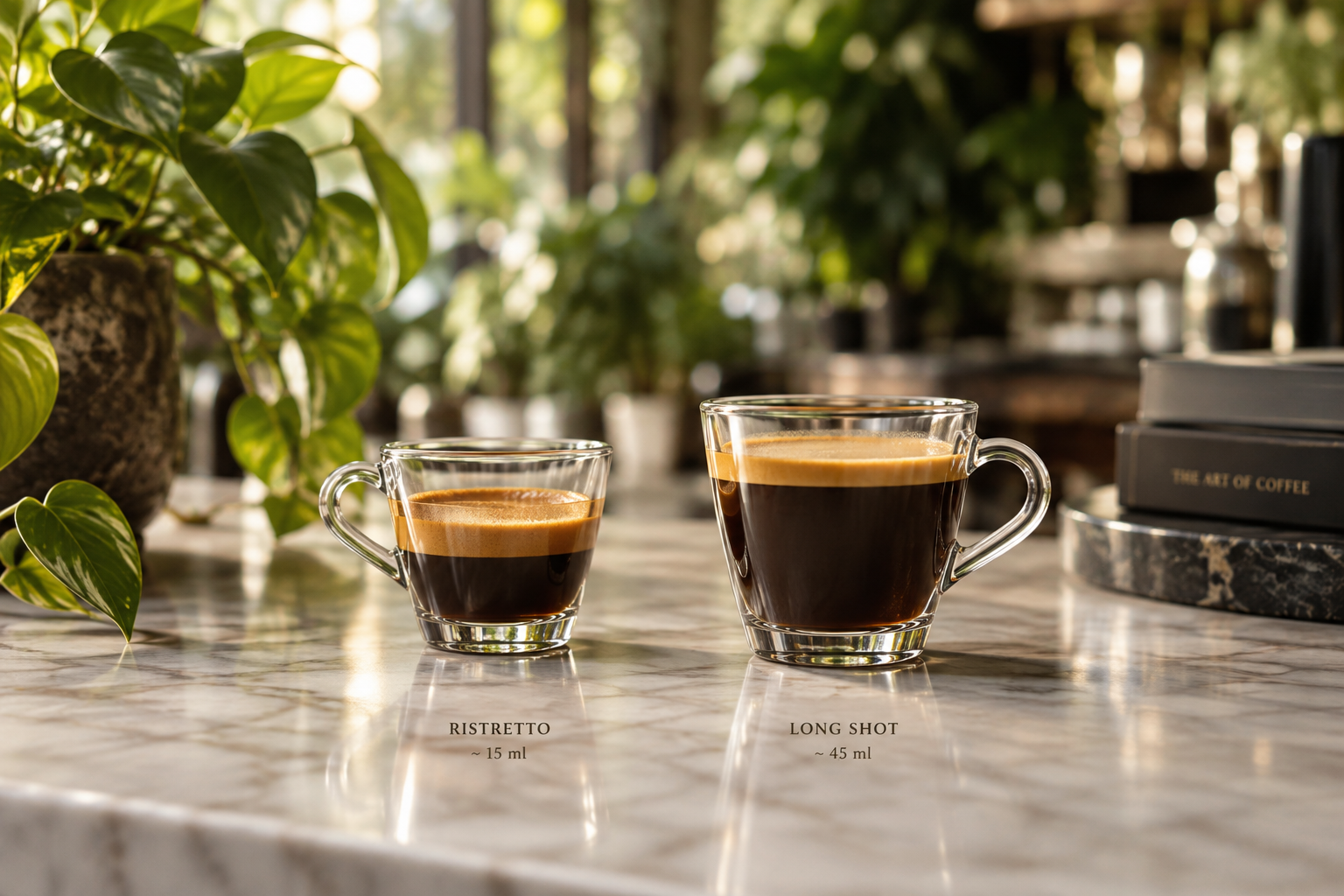
The long shot has more caffeine. Not the ristretto — which is the opposite of what most people expect, and the opposite of what most articles on this subject will tell you.
The confusion is understandable. A ristretto tastes far stronger. It's thicker, more intense, more concentrated in every way you can perceive. But intensity and caffeine are two different measurements, and on the one that actually counts, the long shot wins.
Here's why, and what it means for what you should order.
The short answer
Start with the same 18g of ground coffee in the same basket. The only thing that changes is how much water you push through it.
| Shot | Liquid out | Ratio | Total caffeine | Tastes |
|---|---|---|---|---|
| Ristretto | ~18–27g | 1:1 – 1:1.5 | Least | Thick, sweet, intense |
| Espresso | ~36g | 1:2 | Middle | Balanced |
| Long shot (lungo) | ~54–72g | 1:3 – 1:4 | Most | Thin, bitter, drying |
More water through the same coffee pulls out more of everything — including more caffeine. The ristretto stops early, so a good deal of the caffeine stays behind in the puck and goes in the bin.
What is a ristretto?

A ristretto is an espresso cut short. Same dose of coffee, same basket, same grind — you just stop the shot early, at roughly half the usual volume.
The name is Italian for "restricted," and that's exactly what it is: a restricted pour. Where a standard espresso runs to about twice the weight of the dry coffee, a ristretto stops at around 1:1 to 1:1.5.
What you get is the first part of the extraction only. That matters, because espresso doesn't extract evenly across the shot — the sweet, acidic, aromatic compounds come out early, and the bitter, drying ones come out late. Cut the shot in half and you keep the front and leave the back behind.
That's why a ristretto tastes sweeter and more intense than a full espresso despite containing less total dissolved coffee. You're not getting more. You're getting the better half.
A note on the history you'll read elsewhere
You'll often see a claim that ristretto was invented during wartime rationing, when cafés stretched scarce beans by using less coffee. That story doesn't hold up — using less coffee would produce a weak, under-dosed shot, which is the opposite of a ristretto. A ristretto uses the full dose and less water.
The honest version is less dramatic: pulling shots short is simply what Italian bars did and still do, because it tastes better on the dark roasts traditionally used for espresso, where a full-length shot turns bitter fast.
What is a long shot?

A long shot — or lungo, Italian for "long" — is the reverse. Same dose, same basket, but you keep the pump running well past the normal cutoff, to three or four times the weight of the dry coffee.
More water keeps dissolving more material out of the puck. By the end you've extracted nearly everything available, including the bitter compounds a normal shot deliberately leaves behind. A lungo is usually more bitter and thinner-bodied than an espresso, and that's inherent to what it is, not a sign it was made badly.
A long shot is not an americano
This trips people up constantly, and the difference matters for caffeine.
A lungo pushes extra water through the coffee. More extraction, more caffeine.
An americano is a normal espresso with hot water added to the cup afterward. Same extraction, same caffeine as the espresso it started from — just diluted.
Two drinks that arrive the same size, with meaningfully different caffeine. If you want the bigger hit, the lungo is the one.
What's the actual difference between them?
One variable: water volume. Everything else follows from it.
| Ristretto | Long shot | |
|---|---|---|
| Dose | Same | Same |
| Water through the puck | Less | More |
| Extraction yield | Lower | Higher |
| Total caffeine | Lower | Higher |
| Caffeine per ml | Higher | Lower |
| Body | Thick, syrupy | Thin |
| Dominant flavor | Sweet, acidic | Bitter, drying |
"Caffeine per ml" is where the myth comes from. A ristretto genuinely is more concentrated — sip for sip it delivers more caffeine. But you're drinking half as much liquid, so the total lands lower.
Caffeine content compared
From an 18g dose of a typical coffee, the rough figures look like this:
- Ristretto: around 60mg
- Espresso: around 75–80mg
- Long shot: around 85–100mg
Treat those as approximate. Actual caffeine depends on the bean's species and origin, the roast level, the dose, the grind, and how well the shot was pulled — the variation between two cafés is larger than the variation between these three drinks at one café.
What's reliable is the direction: more water through the same puck extracts more caffeine, every time. Caffeine is highly water-soluble and comes out early in the shot, which is why the gap isn't enormous — a ristretto captures most of it. But "most" isn't "all," and the extra water in a lungo collects the remainder.
For context on how any of this compares to what you'd get elsewhere, we've looked at caffeine in a doubleshot and at how much caffeine is in a McDonald's iced coffee.
Ristretto vs. espresso
A ristretto is an espresso, stopped early. Sweeter, thicker, less bitter, less caffeine, less liquid.
It shines on darker roasts, which turn harsh when pulled long, and in milk drinks — many cafés build their flat whites and cortados on ristretto shots specifically because the concentrated sweetness stands up to milk without the bitterness poking through.
Long shot vs. espresso
A long shot is an espresso taken past its natural stopping point. More caffeine, more liquid, more bitterness, less body.
It works best with lighter roasts, which are dense and hard to extract fully — the extra water that would ruin a dark roast is often exactly what a light roast needs. On a dark roast, a lungo usually just tastes burnt.
Which one is best for a strong coffee kick?
Depends entirely on which kind of "strong" you mean, and people almost always mean the second one without realizing there's a first.
Strong as in caffeine? The long shot. More water, more extraction, more caffeine in the cup.
Strong as in flavor? The ristretto, decisively. It's the most intense, most concentrated coffee experience of the three, and it isn't close.
If you want both — genuinely more caffeine and a drink you enjoy — the right answer is neither. Pull two normal espressos. A doppio from 36g of coffee will beat any single shot on both counts, and it'll taste better than a lungo doing it.
How to choose for your taste
Go ristretto if you like your coffee thick and sweet, you drink dark or medium-dark roasts, you take espresso with milk, or you find full-length shots a bit harsh.
Go long if you drink light roasts, you want something to sip rather than knock back, or you want the most caffeine from a single dose.
Stay with a normal espresso if you're still working out what you like. 1:2 is the default for good reason — it's the most balanced point on the scale, and both of the drinks above are defined by their distance from it.
How to pull each one at home
You don't need a special machine. Both are just an espresso with a different stopping point, so any machine that pulls espresso can pull both.
What you do need is a scale. All three drinks are defined by the ratio of dry coffee in to liquid out, and you cannot judge that by eye — crema hides the true volume and a few grams either way moves you between categories.
- Weigh the dose. Say 18g into the basket.
- Put the cup on a scale and start the shot.
- Stop at your target weight: ~20g for a ristretto, ~36g for espresso, ~60g for a long shot.
- Watch the clock as a sanity check. A ristretto usually lands in 15–20 seconds, espresso 25–32, a lungo 40 or more. If your times are wildly off, adjust the grind rather than chasing the weight.
The grind is what makes or breaks this. Ristrettos in particular expose an inconsistent grind, because you're extracting a narrow slice of the shot and any unevenness in the puck shows up immediately. If your ristrettos taste sour or hollow, the grinder is the first place to look — our Turin grinder comparison and best grinders under $500 both cover what to buy at various budgets, and the grinder matcher will give you a specific recommendation.
Grinders worth knowing at the entry end: the Turin SK40 at $199, the Turin DF54 at $225, and the Turin DF64 at $354 — the last of which is the one we recommend most often.
Frequently asked questions
What is the main difference between a ristretto and a long shot?
Water volume, and nothing else. Both start from the same dose of ground coffee in the same basket. A ristretto stops at roughly half the liquid of a normal espresso; a long shot runs to three or four times the dry coffee weight. Everything else — taste, body, caffeine — follows from that single difference.
Which has more caffeine, a ristretto or a long shot?
The long shot. More water passing through the same coffee extracts more caffeine, so a lungo from an 18g dose lands around 85–100mg against roughly 60mg for a ristretto. The ristretto has more caffeine per millilitre, but you drink far less of it, so the total is lower.
Does a ristretto taste stronger than a long shot?
Yes, clearly. A ristretto is thicker, sweeter and far more intense, because it captures the early part of the extraction where the sweet and aromatic compounds come out. That intensity is why people assume it has more caffeine — but flavour strength and caffeine content are separate things.
Which is better for milk-based drinks?
The ristretto. Its concentrated sweetness holds up against milk without the bitterness cutting through, which is why many cafés build flat whites and cortados on ristretto shots. A long shot tends to disappear into milk and bring its bitterness along.
Can I make both with any espresso machine?
Yes. Both are just an espresso stopped at a different point, so no special equipment is needed. What you do need is a scale — the difference between the three drinks is a matter of grams, and crema makes it impossible to judge by eye.
Is one healthier than the other?
Neither is meaningfully healthier. Both are coffee and water with nothing added. The only real difference is caffeine: if you're limiting your intake, the ristretto is the lower-caffeine choice despite tasting like the stronger one.
Which should I choose if I'm new to espresso?
Start with a standard espresso at a 1:2 ratio. It's the balanced middle point, and both a ristretto and a long shot are defined by how far they sit from it — so you'll understand both far better once you know what the default tastes like.
The short version
Long shot for caffeine. Ristretto for flavour. Most people asking this question want the ristretto and think they want the caffeine.
And if you want a straight answer about grinders, machines, or why your shots aren't tasting the way you want, call us at 800-410-8867. No script, no upsell — we'll tell you if the cheaper option is the right one.