

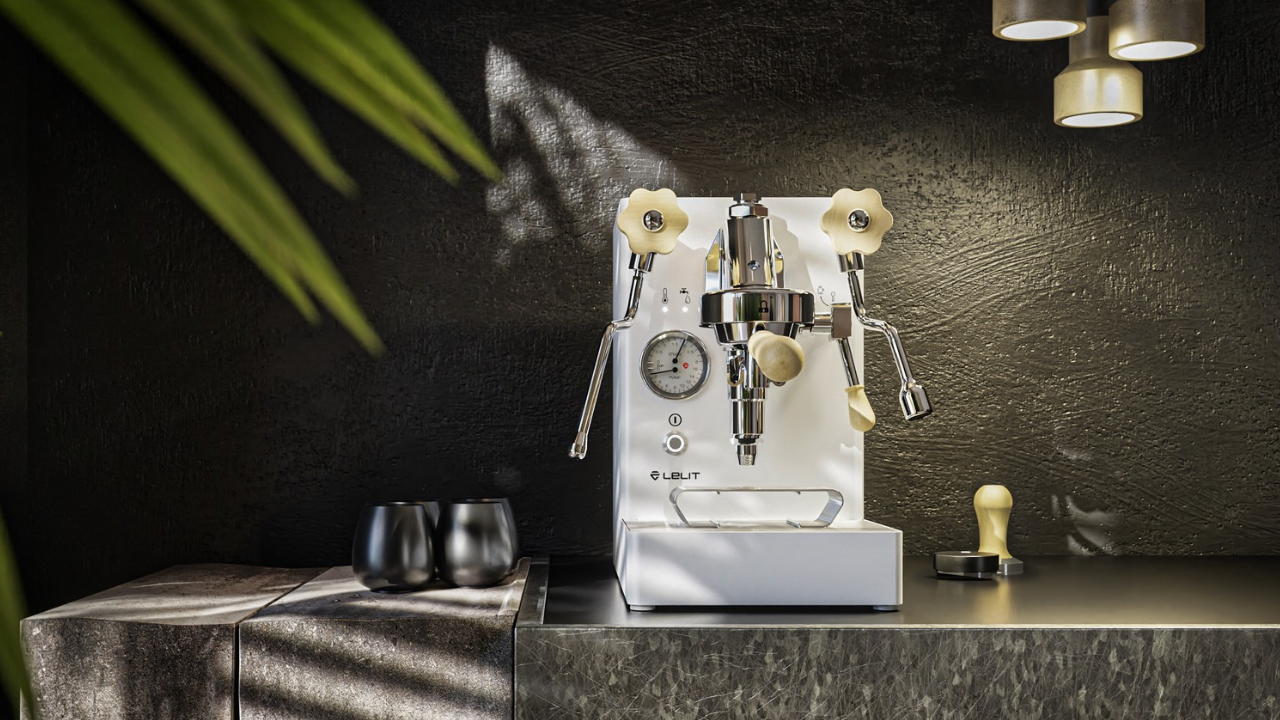
The MaraX is the machine that fixed the oldest annoyance in home espresso: the cooling flush. That's the reason it exists, the reason it sells, and the thing most reviews skip past on the way to describing the water tank.
There are now two of them — the MaraX V2 at $1,699.95 and the newer MaraX3 at $1,999.95. Here's what the machine actually does, and which version to buy.
The problem it solves
Heat exchanger machines are a clever design. One boiler does two jobs: it holds water hot enough for steam, and brew water passes through a tube running inside it, picking up heat on the way to the group.
The catch has always been that steam temperature is much hotter than brew temperature. Leave an HX machine idle and the water sitting in that tube overheats. Pull a shot straight away and you scorch the coffee.
So for decades the answer was the cooling flush: run water through the group before every shot to dump the overheated slug, watch for the hiss to stop, guess when it's right. It works, it wastes water, and it's the single most common reason people's first HX shots taste burnt.
What the MaraX does instead

Lelit's answer is a dual-probe PID. Instead of regulating the boiler by pressure alone — which only tells you about steam — the MaraX also reads temperature at the group and thermosiphon, and it manages the boiler to hit brew temperature first.
The practical result: no cooling flush. Walk up, lock in the portafilter, pull the shot. The machine has been holding the group where it should be the whole time.
That's it. That's the whole pitch, and it's a genuinely good one — it takes the main reason people avoid heat exchangers and removes it, while keeping the reason people want one: brew and steam simultaneously, with steam power a single boiler machine can't match.
MaraX V2 — $1,699.95
| Boiler | Heat exchanger, stainless steel |
| Group | E61 |
| Temperature control | Dual PID |
| Pump | Vibratory, dampened |
| Reservoir | 2.5L removable |
| Portafilter | 58mm |
| Built in | Italy |
Stainless boiler rather than brass or copper, which resists scale and means fewer descaling cycles. ECO mode drops power when it's idle. The pump is noticeably quieter than most vibratory machines — not silent, but you won't wince at 6am.
No flow control. That's the honest limitation, and for most people it isn't one.
MaraX3 — $1,999.95

The newer machine, and the change is significant: Lelit's Pagaia flow control comes standard.
Flow control means shaping the extraction as it happens — easing in gently, ramping to full pressure, then declining through the shot. On most machines that means a mechanical paddle or a retrofitted module. Pagaia does it electronically: a lever adjusts pump power from 0 to 100%, and you read the effect live on the double manometer.
Also new: a silent pump, roughly 15-minute heat-up (fast for an E61 machine), the L58E group — E61-style with mechanical pre-infusion, compatible with LELIT58 tools — and the smoked-oak finishes from the Bianca. Stainless, black or white.
The comparison that matters: flow control on a Lelit otherwise means the Bianca V3 at $2,999.95. The MaraX3 puts it in a compact heat exchanger for a thousand dollars less.
Which one to buy
Take the V2 if you want excellent espresso without another variable to manage. Flow control is a tool for people who want to chase a specific extraction; if you're going to set it once and forget it, you're paying $300 for a lever you won't move.
Take the X3 if you drink light roasts, you already know what flow profiling is and want it, or you'd rather buy the machine you'll grow into. The faster heat-up is a real daily benefit on top.
Our honest split: most people buying their first prosumer machine should take the V2 and put the $300 into a better grinder. People coming from a single boiler who already know their way around a shot usually want the X3.
Living with it
Warm-up is 20–30 minutes on the V2, about 15 on the X3. That's the E61 group's thermal mass, and it's the price of the stability. A $25 smart plug on a schedule makes it a non-issue — the machine is hot before you're awake. We covered that in using a Wi-Fi timer with your espresso machine.
The steam is stronger than you expect. Coming from a single boiler, the first few milk jugs will get away from you. That's normal and it stops being a problem within a week.
Maintenance is undemanding. Backflush weekly with detergent, replace the group gasket every 9–12 months, and treat your water. That last one matters more than the rest combined — scale is the leading cause of espresso machine death and no warranty covers it. Our softening and filtration system is $250, and the water guide explains what you're dealing with.
Who shouldn't buy one
You want coffee in under five minutes. An E61 machine is the wrong tool unless you'll run a timer. The Bambino Plus at $499.95 is ready in under a minute.
You want a grinder included. Neither MaraX has one, and you'll need to budget $200–$400. The Barista Express Impress at $799.95 builds one in.
You specifically want a dual boiler. The Lelit Elizabeth V3 at $1,799 gives you independent brew and steam boilers for less than the X3 — different design, comparable money.
The budget isn't there yet. The Lelit Victoria at $999.95 is the same family, single boiler, and a genuinely good machine.
Browse all Lelit machines · Browse heat exchangers
Frequently asked questions
Do you need a cooling flush with the Lelit MaraX?
No, and that's the machine's main selling point. Its dual-probe PID manages the boiler to hit brew temperature rather than just steam pressure, so the water at the group is already where it should be. Lock in and pull.
What is the difference between the MaraX V2 and the MaraX3?
The X3 adds Lelit's Pagaia electronic flow control as standard, along with a silent pump, a faster roughly 15-minute heat-up, the L58E group with mechanical pre-infusion, and wood finish options. The V2 is $1,699.95; the X3 is $1,999.95.
Is the Lelit MaraX a dual boiler?
No — it's a heat exchanger, which uses one boiler with a tube running through it to heat brew water. You can still brew and steam simultaneously. If you want genuinely independent boilers, the Lelit Elizabeth V3 at $1,799 is the dual boiler in the range.
How long does the MaraX take to heat up?
Around 20–30 minutes for the V2 and about 15 for the X3. That's the E61 group's thermal mass, which is also what makes the machine so stable once it's there. Most owners put it on a smart plug and never experience the wait.
Is flow control worth the extra $300?
If you drink light roasts or enjoy dialing in, yes. If you want to press a button and get consistently good espresso, no — put the money into a better grinder instead. Flow control is a tool for people who want to shape extraction, not a general upgrade.
Does the MaraX come with a grinder?
No. Budget $200–$400 for a decent one — it will affect your espresso more than choosing between the V2 and the X3 does.
How long will a MaraX last?
Well over a decade with sensible care, and it stays repairable throughout — parts are available and it's built to be opened. The thing that actually kills these machines is untreated hard water, not use.
The short version
The MaraX is a heat exchanger that doesn't need a cooling flush, which makes it the easiest E61 machine to live with at this price. Take the V2 at $1,699.95 and spend the difference on a grinder, or the X3 at $1,999.95 if you want flow control and a faster warm-up.
Not sure which? Call us at 800-410-8867. Tell us what you drink and whether you enjoy fiddling — that's the whole decision.