

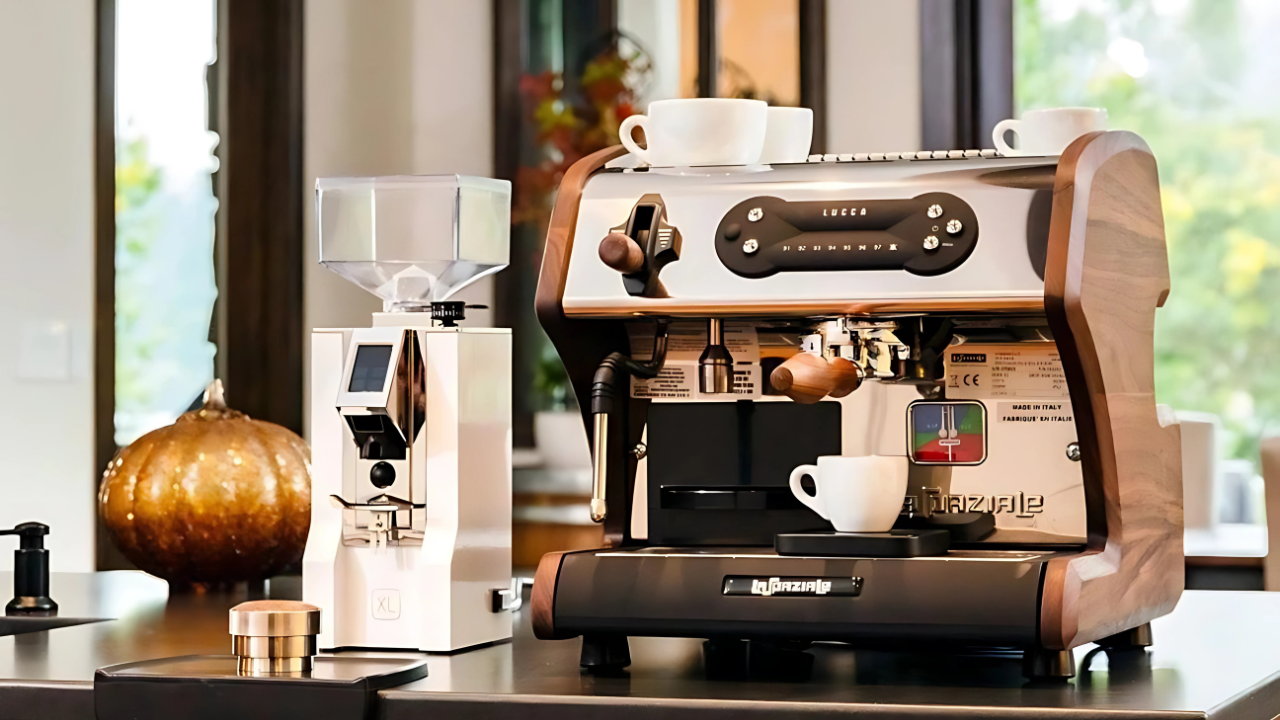
Buy a $500 machine and a $250 grinder, not a $750 machine with a grinder built in. That one decision matters more than which brand you pick, and it is the one almost every beginner gets backwards.
If you want the short list: Breville Bambino Plus ($499.95) paired with a Baratza Encore ESP Pro ($299.95) is the setup we recommend most often. If you would rather have one box on the counter, the Breville Barista Express Impress ($799.95). If you already know this is going to become a hobby, skip ahead to the Lelit Victoria ($999.95).
The decision that actually matters
Every beginner guide leads with brands. The real fork is earlier than that: one machine with a grinder inside it, or two separate boxes.
All-in-one machines put a burr grinder in the same housing as the brewer. One purchase, one footprint, one thing to learn. The compromise is that the built-in grinder is always the weaker half — it has to be small and cheap enough to fit the budget, and it is the component you will outgrow first. When you do outgrow it, you cannot replace it without replacing the machine.
Separates cost about the same in total and give you a meaningfully better grinder, because a standalone $250 grinder is a whole product rather than a subsystem. You also get an upgrade path: when you replace the machine in three years, the grinder stays.
We sell both and we are not precious about it. If counter space is genuinely tight or the idea of two appliances is the thing stopping you from starting, buy the all-in-one and enjoy it. But if it is close, buy separates.
The part nobody tells beginners
The grinder decides more of the taste than the machine does. Espresso is the one brew method where grind consistency is not a refinement — it is the difference between a shot and brown water. A $500 machine with a good grinder beats a $1,200 machine with a bad one, and you can hear the difference from across the room.
The machines
Best first machine — Breville Bambino Plus, $499.95

Heats in about three seconds, takes 54mm baskets, and textures milk automatically — you pick foam level and temperature, put the wand in the pitcher, and it stops on its own.
That automatic milk function is the reason this is our default recommendation rather than something with more prestige. Steaming milk by hand is the skill that takes longest to learn, and the Bambino removes it entirely while you get good at everything else. You can switch to manual steaming later when you want to.
What you give up: it is a single boiler, so you wait between pulling a shot and steaming. For one or two drinks that is fine. It also will not teach you much — it is a machine that works, not a machine that explains itself.
Best value — Turin Legato V2, $479
Our house brand, which means we know what is inside it and we stock the parts. Single boiler, straightforward, no automatic milk assist — you steam by hand from day one.
That is a real trade. It is $20 cheaper than the Bambino and asks more of you. Some people want that; steaming milk badly for two weeks and then suddenly getting it right is a genuinely good feeling. Some people want coffee. Be honest with yourself about which one you are.
Best all-in-one — Breville Barista Express Impress, $799.95

If you want one box, this is the one. The Impress adds an assisted tamping mechanism to the standard Barista Express — you pull a lever and it applies consistent pressure with a small twist at the end to polish the puck.
Tamping unevenly is one of the two or three things beginners do that ruin shots without them understanding why, so automating it removes a whole category of frustration. The built-in grinder is decent, genuinely usable for espresso, and the thing you would eventually replace.
The standard Barista Express ($699.95) is the same machine without the assisted tamp. The $100 is worth it for a beginner.
Best first real machine — Lelit Victoria, $999.95
The step from Breville to Lelit is the step from an appliance to equipment. 58mm portafilter, PID temperature control, metal where the cheaper machines use plastic, and a design that expects to be serviced rather than replaced.
The 58mm size matters more than it sounds. It is the commercial standard, which means every basket, tamper, distribution tool and bottomless portafilter on the market fits it. Start at 58mm and none of your accessories are wasted when you upgrade.
Buy this if you already suspect espresso is going to become a thing you care about. Plenty of people buy a $500 machine, love it, and replace it within a year — at which point they have spent $1,500 to arrive where $1,000 would have put them.
Best hands-off — Breville Barista Touch Impress, $1,499

Guided from a touchscreen: it grinds, tamps, doses, and steams milk to a set temperature and texture, walking you through each step.
This is a legitimate choice, not a cop-out. Some people want excellent coffee and have no interest in the craft, and pretending otherwise sells them a hobby they did not ask for. If that is you, this is your machine and you do not need to read the rest of this page.
If you want to skip a step — Turin Gallatin V HX, $1,249
Not really a beginner machine, but worth naming because a certain kind of beginner buys it and never regrets it.
It is a heat exchanger, which means it steams milk and brews at the same time — no waiting between the shot and the milk. If you are making two or three milk drinks in a row, that changes the morning completely. Full PID, E61-style group, three-hole steam tip.
Buy this if you are confident you will not be satisfied with a single boiler, and you would rather make one purchase than two.
The best beginner espresso grinder
If you buy separates, this is the other half, and it deserves more thought than it usually gets.
A grinder for espresso needs two things a drip grinder does not have: it must go fine enough, and it must adjust in small enough steps. On most grinders built for filter coffee, the gap between two adjacent settings is wider than the entire useful espresso range — so you are choosing between a shot that gushes and one that chokes, with nothing in between. That is not a quality problem. It is the wrong instrument.
Baratza Encore ESP Pro ($299.95) is our usual answer. Purpose-built for espresso, forgiving to dial in, and it handles filter coffee too if you also own a pour-over setup.
Turin SK40 Stepless ($199) is the budget option and the cheapest grinder we would put in front of an espresso machine. Stepless adjustment at a price where almost everything is stepped.
Turin DF54 V 4.1 ($225) is single dosing — you weigh beans in, grind them all out, nothing sits in a hopper going stale. More involved each morning, better coffee, and it is where a lot of people end up eventually anyway.
If you are not sure, our grinder matcher asks four questions and names one.
What beginners overspend on
Dual boilers. Independent brew and steam temperature control is real and useful, and it solves a problem you do not have yet. Buy one when a single boiler's wait genuinely annoys you, not before.
Flow control. Shaping pressure across the shot is an advanced technique that requires a consistent grind to be meaningful. On a beginner grinder it does nothing but add a variable you cannot interpret.
Light-roast capability. Light roasts are unforgiving and hard to dial in. Start on medium, get consistent, then explore.
What beginners underspend on
A scale. Weigh the beans going in and the espresso coming out. Without this you are guessing, and every piece of advice you read becomes impossible to apply because you cannot reproduce anything. A $30 scale does more for your coffee than a $300 machine upgrade.
Fresh coffee. Beans roasted within the last three weeks. Supermarket bags with a best-before date twelve months out will not produce good espresso in any machine at any price.
Water. Scale is what ends espresso machines — not brand, not build quality, not what you paid. It takes one test strip and a minute to find out where your water sits, and it is the single cheapest thing you can do to make an expensive machine last.
Your first two weeks
Expect the first several shots to be bad. This is normal and it is not the machine.
Start at 18g of coffee in, 36g of espresso out, in 25–30 seconds. If it runs faster than that, grind finer. Slower, grind coarser. Change one thing at a time and write down what you changed.
The single most common beginner mistake is adjusting the grind and the dose simultaneously, getting a worse shot, and having no idea which change caused it. Move one variable. Pull a shot. Taste it.
Give it two weeks. Almost everyone who gives up does so in the first four days.
Questions we get
What is the best espresso machine for beginners?
The Breville Bambino Plus ($499.95) for most people, paired with a separate grinder. It heats in seconds and textures milk automatically, which removes the hardest skill while you learn everything else. If you want a single all-in-one unit instead, the Barista Express Impress ($799.95).
How much should a beginner spend on an espresso machine?
Around $750 total is the sweet spot — roughly $500 on the machine and $250 on the grinder. Below about $400 total you are buying something that cannot make espresso properly regardless of technique.
Do I need a separate grinder for espresso?
Not strictly, but a $500 machine plus a $250 grinder beats a $750 all-in-one on taste, and the grinder survives your next machine upgrade. The built-in grinder is the part of an all-in-one you outgrow first and cannot replace on its own.
What is the best beginner espresso grinder?
The Baratza Encore ESP Pro ($299.95). It is built for espresso, forgiving to dial in, and handles filter coffee as well. The Turin SK40 ($199) is the cheapest grinder we would pair with an espresso machine.
Can I use a regular coffee grinder for espresso?
No. Espresso needs a finer grind and much finer adjustment steps than a drip grinder offers. On most, the gap between two adjacent settings is wider than the whole useful espresso range.
Is a dual boiler worth it for a beginner?
No. A single boiler makes you wait 30 to 60 seconds between brewing and steaming, which is a genuine annoyance at three drinks and a non-issue at one. Buy a dual boiler when that wait actually bothers you.
How long does it take to learn to make good espresso?
Expect a couple of weeks to reliably pull a drinkable shot, and a couple of months to get consistent. Most people who give up do so in the first four days, before anything has had a chance to click.
The short answer
Split your budget: about $500 on the machine, about $250 on the grinder. Buy the Bambino Plus and the Encore ESP Pro if you want our default, the Barista Express Impress if you want one box, the Lelit Victoria if you already suspect this will stick.

Then buy a scale and fresh coffee, and give it two weeks before you judge any of it.
If you would rather just describe your situation to a person, call 800-410-8867. We would rather talk you into the cheaper right setup than the more impressive wrong one, and every machine here comes with a 365-day in-home trial.