

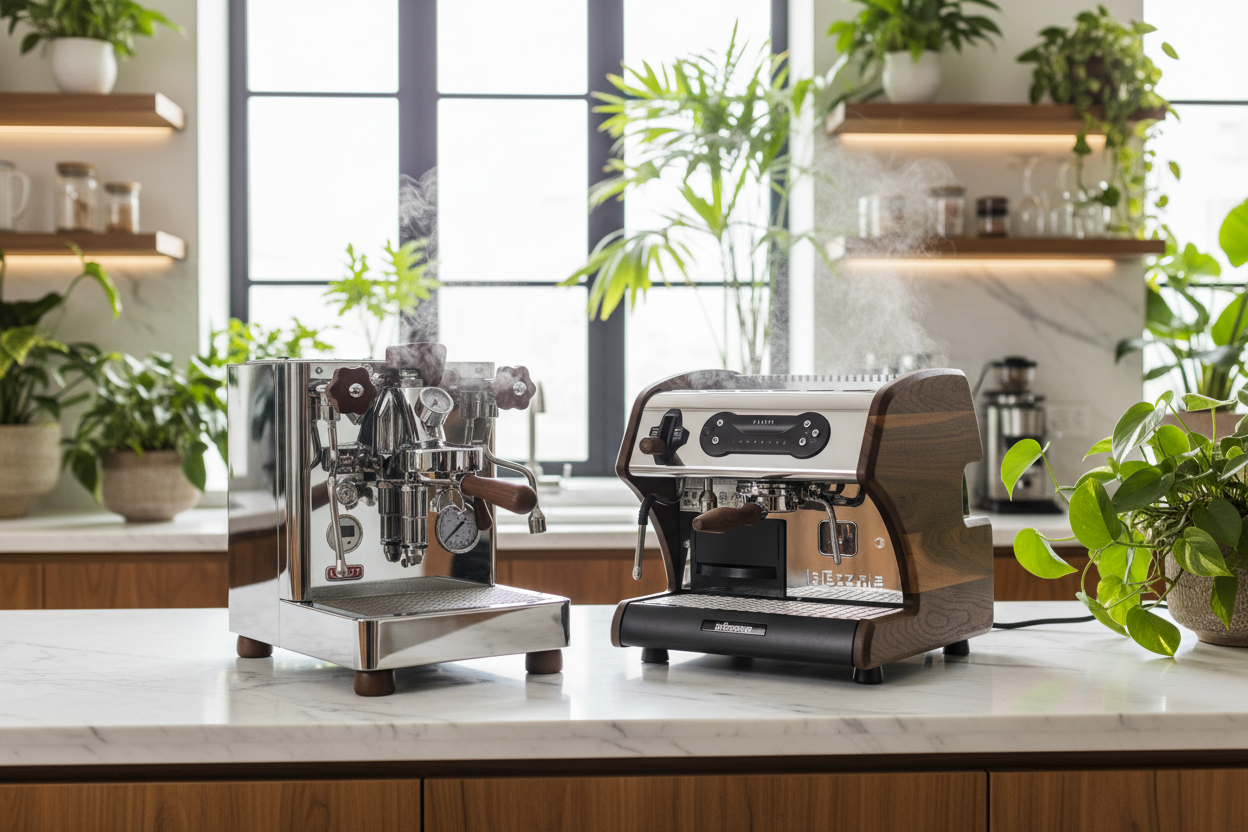
The Lelit Bianca V3 and the LUCCA A53 Mini cost almost exactly the same money, and that is where the similarity ends. These are not two versions of the same idea at different price points. They are two different answers to the question of what a home espresso machine is for.
We sell both. We recommend both. But we recommend them to different people, and the tell is usually obvious within about thirty seconds of talking to someone.
The group head is the real difference
The Bianca uses a classic E61 group — the chrome-domed lever group you have seen on Italian machines for sixty years. The A53 Mini uses a 53mm saturated group, where the brew water sits inside the group itself.
This is not a detail. It shapes everything about how the two machines behave.
The E61 is a large lump of brass heated by a thermosiphon loop. It is enormously well understood, every part is available everywhere, and it will outlive most of the kitchen around it. It also takes its time coming up to temperature, and it rewards a bit of attention — the classic E61 routine of a flush before the shot exists for a reason.
A saturated group heats more directly, because the water is already in the group rather than circulating to it. In practice that means it settles at temperature and stays there with less ceremony. Less to learn, less to think about.

Neither approach is better espresso. They are different relationships with the machine.
Flow control versus volumetric dosing
This is the same split, expressed in the controls.
The Bianca has flow control — the paddle on top of the group that lets you change how fast water reaches the puck, mid-shot. Long pre-infusion, a taper at the end, a ramp in the middle if you feel like it. Every shot is yours to shape.
Related: Lelit Bianca V3 vs. ECM Synchronika: Which Dual Boiler is Better?

The A53 Mini has volumetric dosing. You program a shot, you press a button, and the machine stops at the same place every time. You get repeatability without having to be present for it.
Ask yourself honestly which of those sentences sounds better to you at seven in the morning. That answer is the whole decision.
Living with them
Two practical things that come up more than the spec sheets suggest.
The A53 Mini has a front-loading water reservoir. If your machine is going under a cabinet or against a wall, this matters far more than you would expect — it is the difference between refilling the tank and moving the machine to refill the tank, twice a day, forever.

The Bianca's tank comes out of the side or the rear, and it has flexible placement, but you need access to get at it.
The other thing is the shot routine. The Bianca asks you to warm up, flush, and pay attention. The A53 asks you to press a button. Over a year that is a few dozen hours of your life, and some people want those hours and some people want the coffee.
What the A53 Mini does better
We should be direct about this, because the Bianca gets more attention and that is not the same as being the better machine for you.
The A53 Mini has the easier workflow, full stop. Volumetric dosing, a saturated group that holds temperature without surfing, a reservoir you can actually reach. If your goal is excellent espresso with the smallest possible amount of fuss, it is the better machine, and it is not close.
Related: Lelit Elizabeth V3 vs LUCCA A53 Mini: Which Dual Boiler is Right For You?
It also looks like nothing else on the counter. It is not trying to be a traditional Italian machine, and if you have spent any time looking at E61 machines you will notice immediately that this one has its own idea. We think it is a great looking machine. Some people want the chrome dome. Both are fine reasons to choose.

Bianca V3 vs A53 Mini, side by side
| Lelit Bianca V3 | LUCCA A53 Mini | |
|---|---|---|
| Group | E61 | 53mm saturated |
| Shot control | Flow control paddle | Volumetric dosing |
| Boiler | Dual boiler | Dual boiler |
| Water reservoir | Side or rear, removable | Front loading |
| Plumbable | Yes | No |
| Warm-up | 25 to 30 minutes | 25 to 30 minutes |
| Price | from $2,999.95 | from $2,595 |
Reliability, and the thing that actually kills machines
We are not going to manufacture a difference here, because there isn't one. Both of these machines will run for at least a decade.
What decides that is water. Not brand, not build quality, not how much you spent. Scale is what kills espresso machines, and it kills them regardless of the badge on the front. Use good water from day one and either of these will outlast your interest in them. Ignore it and you will be replacing boilers and valves on whichever one you bought.
If you take one thing from this comparison that isn't about choosing, take that.
Who should skip the Bianca
Who should skip it
Skip the Bianca V3 if you do not want to tinker. Flow control is a genuine capability and it is wasted on someone who wants to make coffee and get out the door — you will pay for a paddle you leave in one position, and you will have bought the machine that asks more of you for no return.
That is not a knock on the Bianca. It is the best machine in this comparison for the person who wants to experiment with every shot. It is simply the wrong machine for the person who doesn't.
Questions we get
Is flow control worth it if I've never used it?
Sometimes. If you are curious about extraction and you enjoy the process, yes — it is the single most interesting thing you can add to a home setup. If you are buying it because reviews say it is good, no. Buy the machine that fits how you will actually behave, not how you hope you will.
Does the saturated group make better espresso than an E61?
No. It makes temperature easier to manage. The espresso is decided by your coffee, your grinder and your recipe, in roughly that order, and both of these machines are well past the point where the machine is the limiting factor.
They're the same price — is one better value?
They are better value for different people, which is an unsatisfying answer but the true one. Value here is about whether you use what you paid for.
Where we stand
If you want to experiment — long pre-infusion, tapering a shot, chasing what a light roast will do if you treat it right — buy the Bianca V3. That is what it is for, and nothing else at this price does it as well.
If you want outstanding espresso with the least friction, buy the A53 Mini. Volumetric dosing, a group that holds temperature, and a reservoir you can reach without moving the machine.
Same money. Genuinely different machines. If you are still unsure after reading this, call us — this is exactly the conversation we are good at, and we would rather talk you into the cheaper right machine than the more interesting wrong one.