

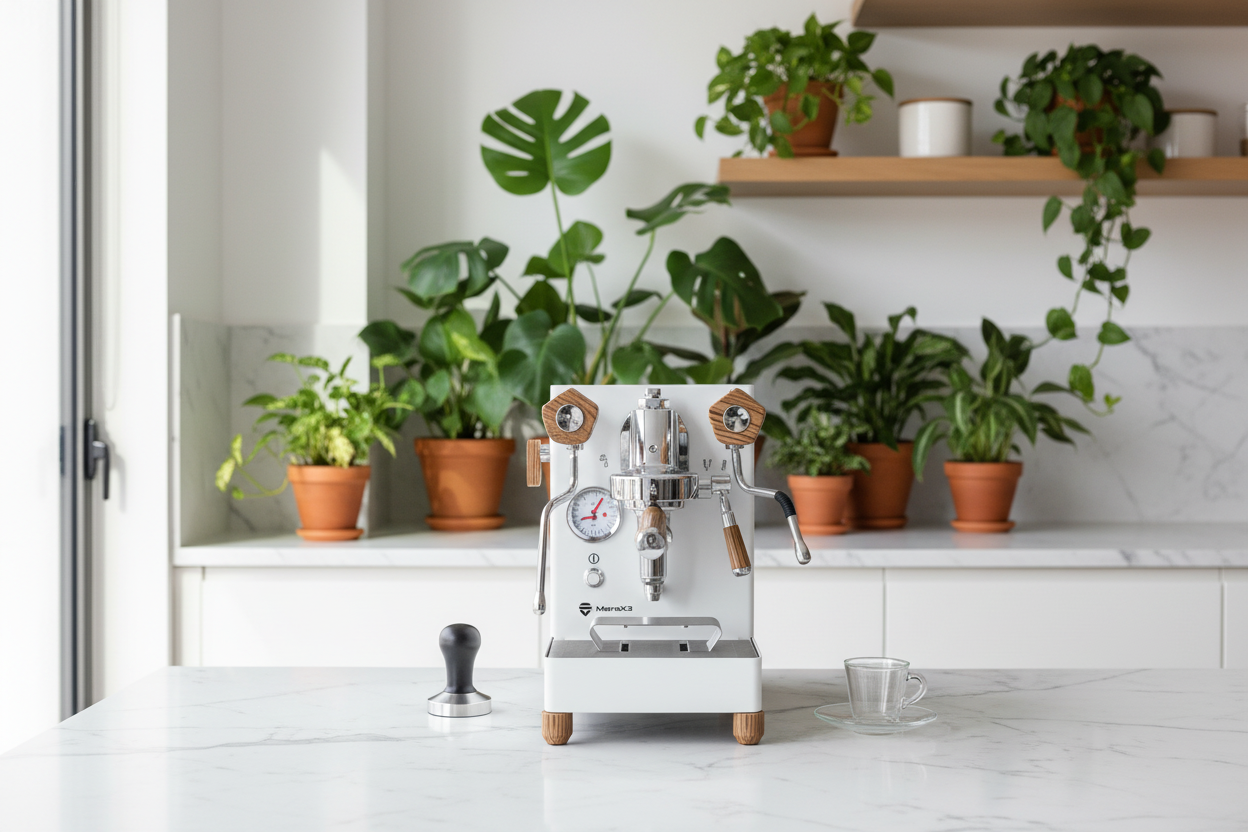
The MaraX has been one of the easiest machines in our lineup to recommend for years. It's compact, it's stable, and it doesn't ask you to babysit it. So when Lelit announced the MaraX3, the first question we got from customers wasn't "is it good?" It was "is it different enough to matter?"
That's the right question, and it has a real answer. This guide covers what changed, what the new Pagaia lever does to your shot, what it can't do, and how to decide between the MaraX3, the older MaraX V2, and the Bianca. We've tried to write the page we'd want to read before spending two thousand dollars.
If you'd rather just talk it through, call us at 800-410-8867. A person who has used these machines will pick up.
The short version
The MaraX3 is a heat exchanger espresso machine built on the same thermal architecture that made the MaraX popular: one 1.8L boiler with a stainless heat exchanger, dual temperature probes, PID control, and thermosiphon circulation. Lelit did not swap that out.

What's new:
- Pagaia, a side-mounted wooden lever that controls pump power in real time. This is the headline feature and the reason the machine exists.
- A redesigned double manometer so you can see what the lever is doing to pressure as the shot runs.
- A three-hole steam tip and a more powerful heating element, which together make steaming noticeably quicker.
- A quieter vibration pump.
- A full cosmetic redesign: smoked oak knobs, lever, feet, portafilter handle and tamper, new drip tray, and metal side ribbons. Stainless, black, and white finishes.
What did not change: the L58E group, the dual-probe PID system, X-Mode brew/steam priority, the three brew temperature settings, and the 2.5L removable tank.
One thing worth knowing up front: the MaraX V2 is not discontinued. Lelit is keeping it in the line at a lower price. That makes this a genuine choice rather than a forced upgrade, which is how we'll treat it below.
What Pagaia actually is

Most flow control you've seen on prosumer machines works with a needle valve. The Lelit Bianca, and the aftermarket kits people bolt onto E61 machines, all work the same way: the pump runs at full power and a valve in the brew path pinches the water down before it reaches the puck. You're adding resistance downstream.
Pagaia does the opposite. The lever doesn't restrict anything. It talks to the pump electronically and changes how hard the pump is working. Rotate it clockwise and pump output climbs toward 100%. Rotate it back and output drops off.
Two practical consequences:
It feels more direct. There's no valve travel, no dead zone, no hunting for the sweet spot in the middle of the paddle's range. Small movements show up on the gauge immediately.
It's built in, not bolted on. On a MaraX V2, getting flow control meant an aftermarket kit and someone willing to open the machine. On the MaraX3 it's a factory component, under factory warranty, with the gauge redesigned to support it.
The lever also has a finger hole, which sounds like a trivial detail until you've tried to make a smooth two-second adjustment mid-shot with a wet hand.
What it lets you do
Once you have direct control over pump power, you can shape the parts of the shot that actually change how the coffee tastes:
- Low-pressure start. Bring the pump on gently, let the puck saturate evenly, then ramp up. Helpful with light roasts and fine grinds that want to channel.
- Blooming shot. Wet the puck, back the pump off to nothing for a few seconds, then come up to full pressure.
- Running the whole shot at 6 to 8 bar. You can do this without opening the machine or touching the OPV. This alone is worth a lot to people who like modern light roasts.
- Tapering the finish. Ease the pressure off in the last few seconds instead of stopping abruptly.
- Nothing at all. Leave the lever at full and the MaraX3 behaves like a standard nine-bar machine. The feature doesn't add complexity unless you ask it to.
What it will not do
Flow control is not a repair tool. Once pressure builds, the puck is in charge. If your grind is wrong, your distribution is sloppy, or you're channeling badly, moving the lever will change the numbers on the gauge and not much else. You still need a grinder that can hold an adjustment, and you still need to dial in.
We say this because the disappointed customers we hear from are almost always people who bought flow control expecting it to substitute for a grinder upgrade. It doesn't. If your current setup is a good machine and a mediocre grinder, put the money in the grinder first. Call us and we'll tell you that on the phone too.
The temperature story

This is the part of the MaraX platform people underrate.
A traditional heat exchanger heats brew water on its way to the group by running it through a pipe inside the steam boiler. That's a clever piece of plumbing, but on most HX machines it means the water sitting in that pipe gets too hot while the machine idles. Hence the cooling flush: you dump water through the group before pulling a shot to get the temperature back into range. It works, but it's guesswork, and it wastes water.
The MaraX uses two temperature probes instead. One reads the steam boiler, one reads the brew side, and the controller manages the boiler to hit your target brew temperature first. No cooling flush, no temperature surfing. That was true of the original and it's true here.
Three brew settings, selected with a button rather than a menu:
| Setting | Approximate brew temp | Typically suits |
|---|---|---|
| Warm | ~190°F / 88°C | Dark roasts, older beans |
| Hot | ~198°F / 92°C | Most medium roasts, everyday blends |
| Extra Hot | ~205°F / 96°C | Light and modern-roasted coffees |
X-Mode switches the machine's priority:
- Coffee mode (brew priority) keeps brew temperature as steady as possible. Steam is still available, it just recovers a little slower.
- Steam mode (steam priority) runs the boiler hotter for faster, drier steam. Brew temperature runs a few degrees above where coffee mode puts it.
That second point causes most of the confusion around this machine. Steam mode is not "better mode." It runs hotter at the group, and it's workflow-sensitive: if you select steam priority and then don't steam milk, your next shot lands hotter than you expected. On the MaraX3 the gap between modes is smaller than it was on the V2, and Lelit has been clearer in the documentation about what the switch is doing. If you drink straight espresso, leave it in coffee mode.
Heat-up: the machine reports ready in roughly twelve minutes. In practice, the brass group takes longer to settle than the boiler does, and back-to-back shots are meaningfully more consistent after about 25 to 30 minutes. Put it on a smart plug and set it to wake up before you do. This is true of every E61-style machine ever made and is not a knock on the MaraX3.
Steam and milk

The three-hole tip is a real upgrade over the V2's two-hole. In independent bench testing, the MaraX3 brought 170ml of milk to 60°C in roughly 27 seconds in steam priority and about 32 seconds in coffee priority. The same test on a V2 runs closer to 40 and 70 seconds.
For a household making two or three milk drinks in a row, that's the difference between a workflow and a wait. It is still a heat exchanger, so you can brew and steam at the same time, which is the main reason people choose HX over a single boiler in the first place.
The wand is insulated and multidirectional, so you're not grabbing hot metal or fighting a fixed joint.
Size, weight, and whether it fits

The MaraX has always sold partly on footprint. People choose it over larger prosumer machines because they don't want a machine that dominates the counter.
Lelit publishes the MaraX3 at 25.5 × 53.5 × 38.5 cm (roughly 10 × 21 × 15 inches) and about 40 pounds. Those published depth and height figures are generous; independent measurement of the body itself comes in narrower, around 8.7 inches wide. The published numbers appear to account for the portafilter, the tank handle, and clearance around the machine.
Two practical notes:
- Under-cabinet clearance is the thing to check, not width. You need room to lift the group lever and to get a hand and a tank in and out from the top. If you're working with a tight cabinet, call us with your measurement before you order and we'll check it against a machine on the floor.
- Forty pounds in a compact body is dense. Plan where it's going before you unbox it, and give yourself a clear path.
MaraX3 vs MaraX V2 vs Bianca
| MaraX3 | MaraX V2 | Bianca | |
|---|---|---|---|
| Type | Heat exchanger | Heat exchanger | Dual boiler |
| Flow control | Pagaia, electronic pump power | None from the factory | Manual paddle, needle valve |
| Temperature control | Dual probe PID, 3 presets | Dual probe PID, 3 presets | Fully adjustable, 1° increments |
| Brew/steam priority | Yes, X-Mode | Yes, X-Mode | Not needed, dual boiler |
| Steam tip | 3-hole | 2-hole | 2-hole |
| Programmable profile | No, manual only | No | Yes |
| Shot timer | No | No | Yes |
| Footprint | Compact | Compact | Noticeably larger |
| Pump | Quiet vibration | Quiet vibration | Rotary |
| Lelit US MSRP | $1,999.95 (stainless) | $1,699.95 | Higher |
Choose the MaraX V2 if you want MaraX performance for less money and you're honest with yourself that you won't use flow control. Plenty of people play with a flow lever for two weeks and then leave it wide open forever. There's no shame in that, and the V2 is still one of the best-value machines we sell.
Choose the MaraX3 if the idea of shaping a shot genuinely appeals to you, or if the design matters to you. The wood and the redesigned body are a real part of what you're paying for, and it's fair to want them. You're spending roughly $300 more than the V2 for the lever, the steam improvement, and the finish.
Choose the Bianca if you want a true dual boiler, independent brew temperature control in one-degree steps, a saveable profile, and a rotary pump, and you have the counter space and budget for it. Shot-to-shot temperature stability on a dual boiler is better than any heat exchanger, full stop. If you make milk drinks back to back for a household every morning, that difference shows up.
We sell all three. We'd rather you buy the right one once.
Living with it
Water is the whole ballgame. Scale is the single most common cause of expensive repairs on machines in this class, and scale damage is generally excluded from warranty coverage. The MaraX3 ships with a 70-liter softener filter for the tank, which is a starting point, not a permanent solution. If you're on hard water, plan on filtered or properly remineralized water from day one. Distilled water straight from the jug is the opposite error and causes its own problems.
Maintenance is ordinary. Backflush with the included blind basket, replace the group gasket when the portafilter starts locking past six o'clock, and keep the shower screen clean. A spare L58E group gasket comes in the box.
Basket and portafilter compatibility. Standard 58mm baskets fit, including third-party IMS baskets. The portafilter handle itself, including bottomless portafilters, needs to match Lelit's L58E lug pattern, so a generic 58mm bottomless won't necessarily lock in. Ask us before you buy accessories and we'll tell you what actually fits.
In the box: the LELIT58 two-way portafilter with the wooden handle, IMS baskets in 9–11g, 14–18g and 18–21g plus a blind basket, a matching tamper, cup rack, the softener filter, a cleaning kit, and a spare group gasket.
Support. Lelit has been owned by Breville since 2022, which in practice means US parts availability and service infrastructure are in better shape than they are for a lot of imported Italian equipment.
Questions we get
Is the MaraX3 a dual boiler? No. It's a heat exchanger: one boiler, with brew water heated on its way to the group. It behaves like a dual boiler in one respect, since you can brew and steam simultaneously, but shot-to-shot temperature stability on a real dual boiler is better.
Do I need to do a cooling flush? No. The dual-probe PID system is specifically designed to make that unnecessary.
Can I use the machine without touching the Pagaia lever? Yes. Leave it at full power and it runs as a conventional nine-bar machine.
Will flow control fix my bad shots? No. It gives you control over how pressure builds and falls. It does not compensate for a grinder that can't hold an adjustment or for channeling.
Is the MaraX V2 discontinued? No. Lelit is keeping it in the lineup at a lower price.
How long should I let it warm up? It reports ready in about twelve minutes. For consistent back-to-back shots, give it closer to thirty.
Does it need to be plumbed in? No. It runs from a 2.5L removable tank with handles.
What grinder do I need? Something with genuine espresso resolution. If your grinder can't make small, repeatable changes, the machine's capabilities won't reach the cup. Call us with your budget and we'll tell you honestly whether to spend it on the grinder or the machine.
Can I pull a shot and steam milk at the same time? Yes. That's the core advantage of the heat exchanger design.
Which color should I get? Stainless, black, and white are mechanically identical. Lelit is explicit that performance in the cup is the same across finishes.
Where we stand
The MaraX3 is not a cosmetic refresh with a gimmick attached, and it's not a reinvention either. It's a well-sorted machine that got a genuinely useful new control, better steam, and a much nicer set of clothes. If you want to shape shots and you want to do it in a compact machine without aftermarket surgery, there isn't much else at this price doing what it does.
If you're not sure it's your machine, that's a conversation, not a checkout button. Call 800-410-8867 and ask for whatever you actually want to know. And if you do buy it and it turns out to be wrong for you, our 365-day return promise means you have a full year to figure that out, not thirty days.
Not sure where to start? Our Find My Machine quiz takes about two minutes.
Current pricing, finishes, and availability for the Lelit MaraX3 →