

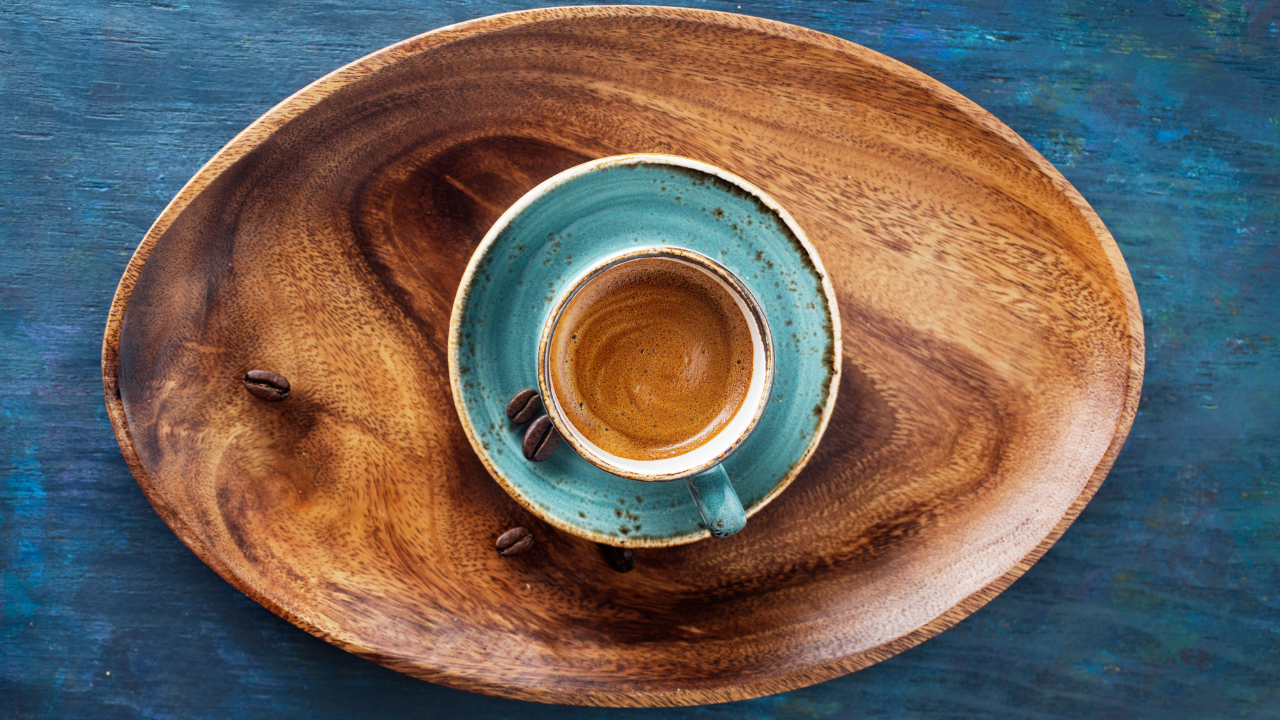
Espresso is hot water forced through a compressed bed of finely ground coffee under roughly nine bars of pressure. Everything that makes a shot taste good or bad comes out of four variables — dose, grind, time and temperature — and understanding how they interact is the difference between guessing and dialing in.
Here's what's actually happening, and how to use it.
The numbers worth memorizing
| Variable | Standard |
|---|---|
| Dose (double) | 18–20g |
| Yield | 36–40g liquid out |
| Brew ratio | 1:2 |
| Shot time | 25–30 seconds |
| Pressure | 9 bar |
| Water temperature | 195–205°F (90–96°C) |
| Extraction yield | 18–22% |
Start at 18g in, 36g out, 27 seconds. Adjust from there. These are a reference point, not a rule — but if you don't know where you are, this is where to stand.
What extraction actually means

Roasted coffee is only about 30% water-soluble. The rest is insoluble plant structure that stays in the puck no matter what you do. Extraction is the business of dissolving some portion of that 30% and getting it into the cup.
Extraction yield is the percentage of the dry coffee's mass that ended up dissolved in your drink. Below about 18% and you've left too much behind. Above about 22% and you've started pulling out compounds nobody wants. The window between them is where good espresso lives.
The critical part is that coffee's compounds don't dissolve at the same rate, and they come out in a rough order:
- First: acids and salts. Bright, sharp, sour.
- Next: sugars and Maillard products. Sweetness, caramel, chocolate, body.
- Last: larger, less soluble compounds — dry, harsh, astringent bitterness.
That sequence is the entire diagnostic. Stop too early and you've collected the acids without the sugars that balance them. Run too long and you've added the harsh compounds on top of everything else.
Sour or bitter: the only diagnosis you need
Nearly every bad shot is one of two problems, and they have opposite fixes. Getting the diagnosis right is most of the skill.
Under-extracted tastes sour and thin. Sharp, acidic, empty in the middle, sometimes salty. It finishes fast and leaves nothing behind. The shot usually ran quick. Water moved through the bed too easily — grind too coarse, dose too low, or channeling.
Fix: grind finer, or raise the dose. Go one step at a time.
Over-extracted tastes bitter and dry. Harsh, ashy, and it leaves your mouth feeling stripped — that drying sensation is astringency, and it's the clearest single indicator. The shot usually ran slow.
Fix: grind coarser, or cut the shot shorter.
The confusing case is a shot that's both, which means the water didn't move through the bed evenly — some of the coffee was over-extracted while other parts were barely touched. That's channeling, and it's a puck preparation problem rather than a grind problem. We covered the whole diagnostic in why your espresso tastes bitter.
The four variables, and which to change first
Grind size is the most powerful lever and the one you should be adjusting daily. Finer means more surface area and more resistance, so water moves slower and extracts more. Coarser means the reverse. Coffee also changes as it ages, so the setting that was right last week won't be right this week. This is normal.
Dose changes the depth of the bed and therefore its resistance. Most 58mm baskets are built around 18g. Overfilling causes the puck to hit the shower screen; underfilling leaves headspace where water pools.
Time and yield are how you decide when to stop. Weigh the output — 36g from 18g in. Judging by eye is the most common reason people can't repeat a good shot, and a $70 scale removes the problem permanently.
Temperature is the fine-tuning control. Higher temperature increases solubility across the board, so it extracts more of everything. Light roasts are denser and harder to extract and generally want the top of the range; dark roasts are brittle and already partly broken down, so they want the bottom or they turn ashy.
Change one thing at a time. Changing two means you learn nothing from the result.
The compounds doing the work

Acids. Chlorogenic, citric, malic, phosphoric. They give espresso its brightness and its structure. Roasting breaks chlorogenic acids down into lactones and, at darker levels, phenylindanes — and those are the primary source of roast bitterness.
Sugars and Maillard products. Raw coffee contains sucrose, most of which is consumed during roasting in the Maillard reaction and caramelization. What's left behind are hundreds of aromatic compounds responsible for the chocolate, nutty, caramel and bready notes. Almost everything you taste as sweetness in espresso is this, not actual sugar.
Lipids. Coffee oils, which pressure emulsifies into the shot. They carry aroma and produce the heavy, coating mouthfeel that distinguishes espresso from filter coffee — a paper filter removes them, which is why drip tastes cleaner and thinner.
Caffeine. Worth correcting a common claim here: caffeine is bitter, but it accounts for only a small fraction of coffee's perceived bitterness. The roast-derived compounds above do most of that work. Decaf tastes bitter for the same reasons regular coffee does.
What crema actually tells you
Crema is a foam of carbon dioxide, trapped by emulsified oils and soluble proteins. The CO₂ is a byproduct of roasting that stays dissolved in the beans and comes out of solution under pressure.
Which means crema is primarily a freshness indicator, not a quality one. Beans a few days off roast produce thick crema; beans three weeks old produce little regardless of how well you pull the shot. Robusta produces more crema than arabica, which is why cheap supermarket blends often look impressive and taste poor.
Judge the shot by taste. Plenty of exceptional light-roast espresso has thin, pale crema.
Water is a variable too
Espresso is around 90% water, and what's dissolved in it participates directly in extraction — minerals bind to flavor compounds and carry them into the cup. Water with almost nothing in it extracts poorly and tastes hollow; water with too much hardness scales your boiler.
The target is roughly 50–85 ppm hardness and around 40 ppm alkalinity. It's covered properly in water for espresso, and it's the variable most people never touch despite it being in every shot they pull.
Where the equipment comes in

Understanding the theory only helps if the hardware can act on it. The two things that matter are grind adjustment fine enough to make small changes and temperature stability across the shot.
A grinder with coarse steps will jump straight past the setting you want. This is why grinder upgrades change people's coffee more than machine upgrades do — the Baratza Encore ESP at $199.95 is the usual starting point, and the Turin DF54 at $225 steps up to flat burrs and stepless adjustment.
On machines, a PID controller holds brew temperature to within a degree rather than letting it swing. The Barista Express Impress ($799.95) has one along with a built-in grinder; dual boiler machines add independent temperature control for brewing and steam.
Browse espresso machines · Browse grinders
Frequently asked questions
What is espresso extraction?
The process of dissolving soluble compounds out of ground coffee using hot water under pressure. Roasted coffee is only about 30% soluble, and good espresso dissolves 18–22% of the dry coffee's mass into the cup. Below that range the shot tastes sour; above it, bitter.
Why does my espresso taste sour?
Under-extraction. Water passed through the coffee too quickly to pick up the sugars that balance coffee's acids, so you're tasting the acids alone. Grind finer or increase your dose, changing one variable at a time.
Why does my espresso taste bitter?
Usually over-extraction — the shot ran long enough to dissolve harsh, astringent compounds on top of the good ones. Grind coarser or stop the shot earlier. Very dark roasts taste bitter regardless, because roasting itself produces bitter compounds.
What is the correct brew ratio for espresso?
1:2 is the standard starting point — 18g of coffee producing 36g of liquid espresso in 25 to 30 seconds. Shorter ratios (1:1.5) give a more concentrated, syrupy shot; longer ratios (1:3) give a lighter, more extracted one.
Does more crema mean better espresso?
No. Crema is carbon dioxide trapped in emulsified oils, so it mainly indicates how recently the beans were roasted. Robusta produces more crema than arabica despite generally tasting worse. Plenty of excellent light-roast espresso has thin, pale crema.
What temperature should espresso be brewed at?
Between 195°F and 205°F (90–96°C). Light roasts are denser and harder to extract, so they generally benefit from the upper end of that range. Dark roasts extract more readily and usually taste better toward the lower end.
Which matters more, the grinder or the machine?
The grinder, for most people. Espresso needs grind adjustments fine enough to move the shot by a couple of seconds, and a grinder with coarse steps will jump past the setting you want no matter how good the machine is.
The short version
18g in, 36g out, 27 seconds, 9 bar, around 200°F. Sour means grind finer, bitter means grind coarser, and both at once means the puck isn't even. Change one variable at a time and weigh the output.
Stuck on a particular machine or grinder? Call us at 800-410-8867 and we'll work through it with you.